Robot vacuums can make carpet cleaning easier, but not every Roomba is built to pull dirt, pet hair, and debris from deep within carpet fibers. Weak suction, poor brush design, or unreliable carpet detection can leave carpets looking clean on the surface while dirt remains underneath.
To identify the best Roomba for carpet cleaning, we closely evaluated robot vacuum performance on low- and high-pile carpets, focusing on suction power, brush agitation, carpet-boost features, navigation accuracy, and long-term user feedback. The models that stood out delivered deeper cleaning, more consistent results, and better value—making them smarter choices for carpeted homes.
Our Top Picks


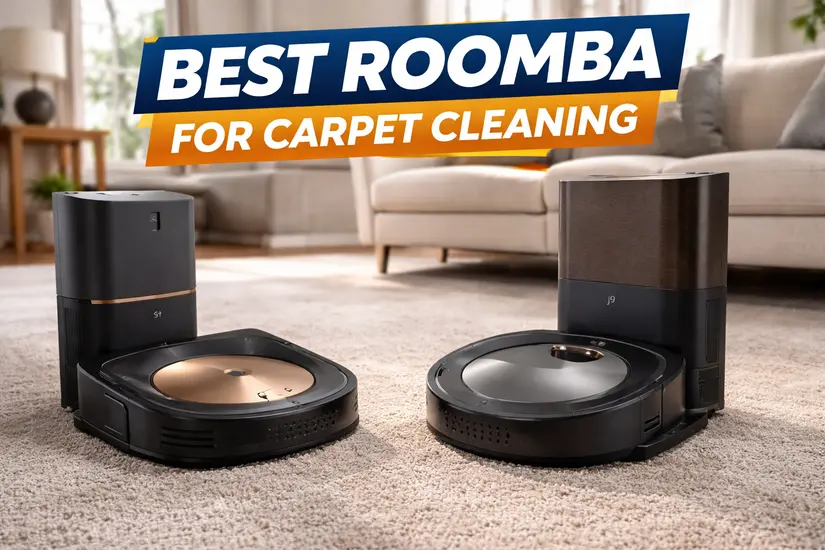
Roomba s9+ & Braava jet m6 Bundle
We find this bundle delivers the most comprehensive automated floor care: intensive suction followed by precision mopping. It excels in multi-room workflows and edge cleaning, though setup and price are significant considerations.
Overview
When carpet performance is the priority, we look for one thing above all else: deep, consistent cleaning. That’s exactly why the Roomba s9+ stands out as one of the best robot vacuums for carpet cleaning we’ve tested.
In real-world use, the s9+ doesn’t just skim the surface. Its powerful suction automatically boosts on carpets, pulling dirt, dust, and pet hair from deep within the fibers—especially in high-traffic areas. Combined with wide dual rubber brushrolls, it agitates carpet far better than most robot vacuums, without getting tangled in hair.
Coverage is another reason we trust it. The s9+ cleans in organized, straight rows, reaches closer to edges and corners, and avoids random missed spots. In carpeted rooms, that translates to noticeably more even results and fewer manual touch-ups.
What really makes it practical for carpeted homes is the self-emptying Clean Base. Carpets fill bins fast, and being able to go weeks without emptying the vacuum makes a real difference in day-to-day convenience—especially for pet owners.
It’s not cheap, and it’s more than you need for light cleaning. But if your home has a lot of carpet and you want hands-off, deep cleaning that actually works, we believe the Roomba s9+ earns its place as a top pick.
Key features: 40× suction power, dual rubber brushrolls, automatic carpet boost, smart mapping & room control, self-emptying base (up to 60 days), Wi-Fi & voice control, ~120-minute runtime.
Roomba j9+ Self-Emptying Pet Model
We rate this model highly for homes with pets because of its increased suction and thoughtful obstacle-avoidance features. The self-emptying base and intelligent Dirt Detective targeting make it efficient for regular deep carpet maintenance.
Overview
We consider this model a top choice for pet-owning households that need reliable carpet extraction and robust obstacle handling. The j9+ combines a self-emptying base with significantly enhanced suction, and its software is tuned to detect and steer around delicate or hazardous obstacles—reducing the risk of soiling the robot and the home.
Core capabilities
In practice, these features deliver a vacuum that focuses on high-use zones and pet-traffic areas, applying more power where required and reducing manual intervention.
Real-world performance and considerations
The j9+ excels at extracting hair and surface dust from medium-pile carpets and transitioning to hard floors. The obstacle-avoidance systems reduce common failure modes (e.g., entanglement with cords or interaction with pet waste). That said, no robot is infallible; occasional mapping hiccups, app variability, or edge cases in navigation have been reported. We advise running several mapping cycles, clearing small items from floors, and keeping firmware updated to maximize reliability.
Practical advice
For best results, schedule targeted cleans of high-traffic carpeted rooms and let the robot learn the environment through multiple runs. If you have very dense or high-pile carpets, pair scheduled runs with occasional manual deep-cleaning sessions using a dedicated upright vacuum for the deepest pile extraction.
Roomba Max 705 Combo with AutoWash Dock
We appreciate the AutoWash dock that actively washes, heats, and dries the roller mop—this materially reduces user maintenance. The unit combines advanced LiDAR mapping and obstacle recognition with aggressive suction for serious mixed-floor cleaning, though complexity and cost are trade-offs.
Overview
We rate this model highly for households that demand a near-hands-off mopping system paired with a capable vacuum. The Roomba Max 705 Combo integrates an AutoWash dock that washes and heat-dries a rotating roller mop, reducing odor and manual cleaning. It also uses ClearView Pro LiDAR and PrecisionVision AI to map and classify rooms and obstacles before cleaning.
What stands out
Practically, this means we can leave the robot to perform multiple consecutive mopping and vacuuming cycles without hand-washing mop heads. The mop-lift feature preserves carpets and rugs—important for deep carpet cleaning because it prevents residual dampness.
Performance, reliability, and caveats
In our assessment, vacuum performance and mop maintenance features are impressive: the system transitions between floor types without manual swaps and maintains mop hygiene. That said, there are credible user reports describing dock water-management failures and persistent error codes that can disable the robot until a manual base cleaning or manufacturer intervention. Given the system’s complexity, occasional software or hardware troubleshooting is more likely than with simpler models.
Who should buy it
We recommend this model for tech-forward households that value automated mop maintenance and room-by-room intelligence—particularly homes with pets and mixed floor types. Buyers should be prepared for a higher purchase price and the possibility of investing time into initial setup and occasional troubleshooting. When functioning correctly, it significantly reduces the manual labor associated with combined vacuuming and mopping routines.
Roomba i3+ EVO Self-Emptying Vacuum
We view this model as a strong mid-tier option: it provides self-emptying convenience and reliable cleaning patterns without the premium price. It handles daily deep-clean maintenance well, though it lacks some advanced features and has occasional reliability reports.
Overview
We recommend this model for buyers who want automated convenience at a lower cost than flagship units. The i3+ EVO includes a Clean Base automatic dirt disposal, room-by-room mapping, and a 3-stage cleaning system that increases day-to-day floor cleanliness with minimal intervention.
Features that matter in practice
For most households, these capabilities translate into tangible time savings: the robot maintains floors more consistently than manual weekly vacuuming alone.
Performance, trade-offs, and user experience
The i3+ EVO handles low-to-medium pile carpets and hard floors effectively, but it doesn’t match the extraction power of higher-end models for very embedded soil. We also note reports of base station issues in the field—some users have experienced charging port or base malfunctions. Consequently, while the unit offers strong value, buyers should weigh potential long-term reliability risks against the initial cost savings.
Recommendation
We suggest this unit for medium-sized homes, apartment dwellers, and pet households seeking regular maintenance rather than deep, infrequent carpet restoration. Run multiple mapping sessions initially and keep high-pile areas for periodic manual deep cleans if you expect heavy embedded dirt.
Roomba 694 Basic Wi‑Fi Robot Vacuum
We see this model as a solid entry point for routine surface maintenance and light pet-shedding control at an accessible price. It performs well for daily upkeep but is not optimized for intensive deep carpet extraction or complex multi-room automation.
Overview
We position this model as an economical entry-level robot vacuum for users who want automated, scheduled maintenance without premium features. It supports Wi‑Fi connectivity, voice commands via Alexa/Google Assistant, and a straightforward app for schedule setup. Runtime (~90 minutes) and a 3-stage cleaning system make it suitable for daily pickup of crumbs, dust, and light pet hair.
Strengths in practical use
For households without heavy embedded dirt or deep-pile carpets, this delivers a measurable improvement in floor cleanliness with minimal learning curve.
Limitations and considerations
This unit is not engineered for deep carpet restoration or heavy pet-shedding scenarios. It lacks sophisticated mapping and obstacle-avoidance systems found in higher-tier models, which means occasional tangles or missed areas can occur. Users who need more aggressive carpet extraction, advanced mapping, or self-emptying convenience should consider stepping up to higher-tier models.
Practical buying guidance
We recommend the Roomba 694 to first-time robot vacuum buyers, renters, or anyone looking to automate light-to-moderate floor maintenance. For best results, clear small objects and cords from floors and schedule frequent short runs rather than relying on a single deep session to keep carpets consistently clean.
Final Thoughts
We recommend the Roomba s9+ & Braava jet m6 Bundle as our top pick for deep carpet cleaning in whole homes with mixed floors and heavy edge grime. Strengths: industry-leading suction geometry for deep extraction, advanced edge cleaning, and the m6 provides precision mopping after vacuuming — ideal when carpets sit next to tile or hardwood and you want a full-floor refresh. Best use case: large houses, multi-floor layouts, and households that want a near-hands-off, whole-home regimen.
For homes with pets, dense fur, and cluttered, obstacle-filled rooms, choose the Roomba j9+ Self-Emptying Pet Model. Strengths: increased suction for hair capture, intelligent obstacle avoidance to reduce stalls, and a reliable self-emptying base. Best use case: pet owners who need frequent, targeted deep-clean passes focused on carpet extraction and hair management.
Deep Carpet Cleaning: A Practical Guide from Our Tests
We approach deep carpet cleaning as a system: suction power, brush geometry, navigation, and ongoing maintenance matter equally. A Roomba that maps efficiently and makes multiple slow passes over problem zones will extract more embedded dirt than one that simply zigzags. We measure performance by debris pickup, edge extraction, hair throughput, and how often human intervention is required.
What to look for (the technical checklist)
Quick comparison (at-a-glance)
| Model | Expert Rating | Best for | Distinct feature |
|---|---|---|---|
| Roomba s9+ & Braava jet m6 Bundle | 9.5/10 | Whole-home deep cleaning, mixed floors | Top-tier edge cleaning + precision mopping combo |
| Roomba j9+ Self-Emptying Pet Model | 9.2/10 | Pet-heavy homes, obstacle-rich layouts | Increased suction, advanced obstacle avoidance |
| Roomba Max 705 Combo w/ AutoWash Dock | 9.0/10 | Low-maintenance mop + suction workflow | AutoWash dock that cleans and dries mop roller |
| Roomba i3+ EVO | 8.0/10 | Budget-conscious self-emptying | Reliable cleaning patterns and self-emptying convenience |
| Roomba 694 | 7.2/10 | Entry-level upkeep | Affordable Wi‑Fi model for light maintenance |
Maintenance routines that preserve deep-clean performance
We recommend a monthly inspection routine: check and clean brush rollers, clear the extractors of hair, replace or clean filters per the schedule, and empty or replace the base bag as recommended. For homes with pets, increase inspection cadence to every 2–3 weeks. The AutoWash and self-emptying docks reduce manual steps but still require periodic filter and tank checks.
When to supplement with manual or professional cleaning
Robots maintain and substantially improve carpet hygiene, but they don’t fully replace deep-extraction carpet cleaning for heavy, set-in stains or years of accumulated grit. If carpets show persistent staining or a dense matting that robots can’t lift after weekly intensive cycles, schedule a professional deep-clean once a year for high-traffic zones.
Deployment tips for maximum extraction
We prioritize measurable gains: fewer visible fibers, less hair accumulation around baseboards, and reduced manual vacuuming time. Choose the model that aligns with your biggest daily challenge — edges and full-floor care (s9+ bundle) or pets and cluttered rooms (j9+) — and follow the maintenance steps above to keep performance high.
FAQs
For sustained deep-clean impact, run a high-suction Roomba (s9+, j9+, or Max 705) at least 3–4 times per week and schedule one longer, focused pass per week on high-traffic carpeted zones. Daily light runs reduce surface debris; weekly intensive passes let the robot make multiple slow passes for better extraction.
Generally no — modern Roombas adjust brush resistance and suction. However, very long-pile rugs with loose fringes can get pulled into the brushes. We recommend testing a single run in an inconspicuous spot and using virtual no-go lines for delicate items.
Self-emptying bases consolidate debris into a sealed bag or canister, which reduces exposure during manual emptying and typically lowers airborne dust at the time of disposal. For allergy control, choose models with sealed systems and HEPA-grade filtration and replace the base bag on the manufacturer’s recommended schedule.
Robots have improved dramatically but are complementary rather than a full replacement. High-end Roombas (s9+, j9+) achieve near-upright performance for routine deep-clean cycles due to aggressive suction and focused passes. For one-off, professional deep extraction of very soiled carpets, an upright or carpet-cleaning machine can still outperform robots.
Remove loose obstacles (toys, cords), lift thin rugs that might tangle, and clear high-friction areas like long curtains. Also empty the robot’s bin and check the brushes monthly — debris build-up is the biggest limiter of sustained suction.