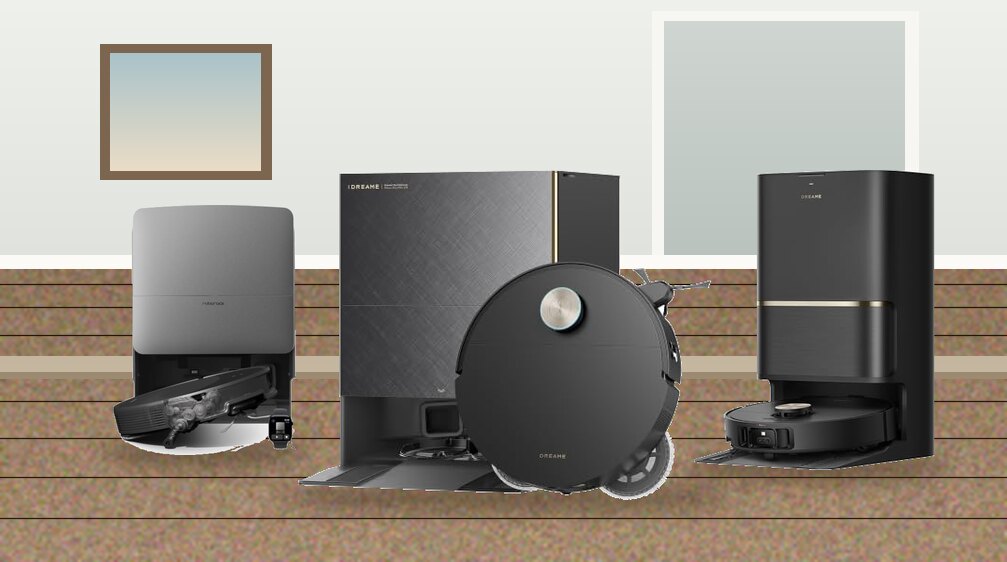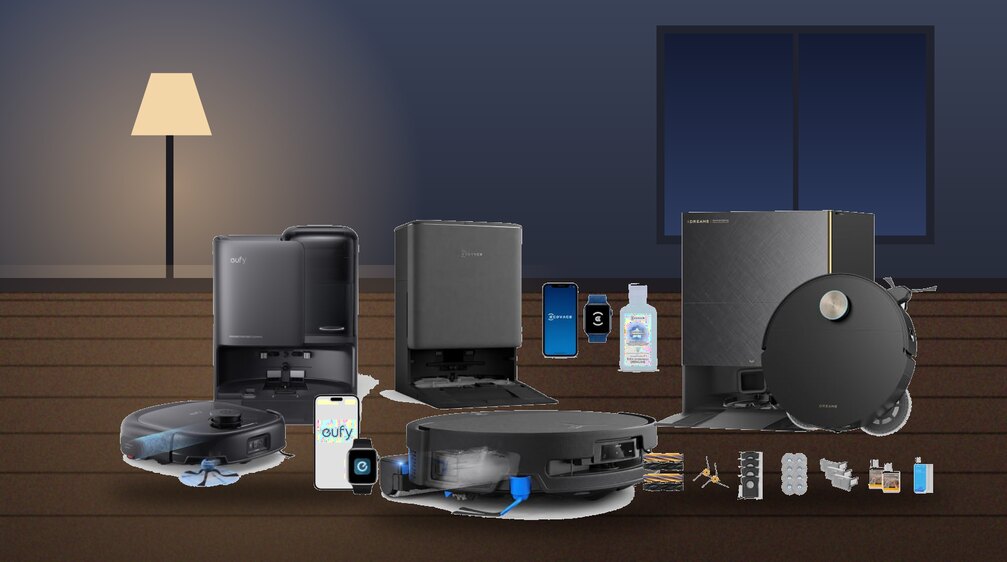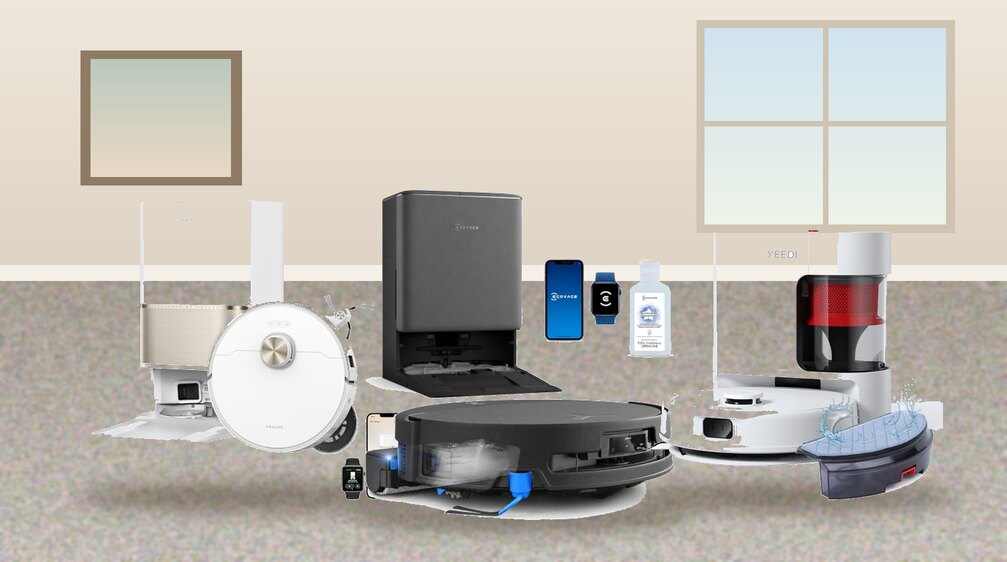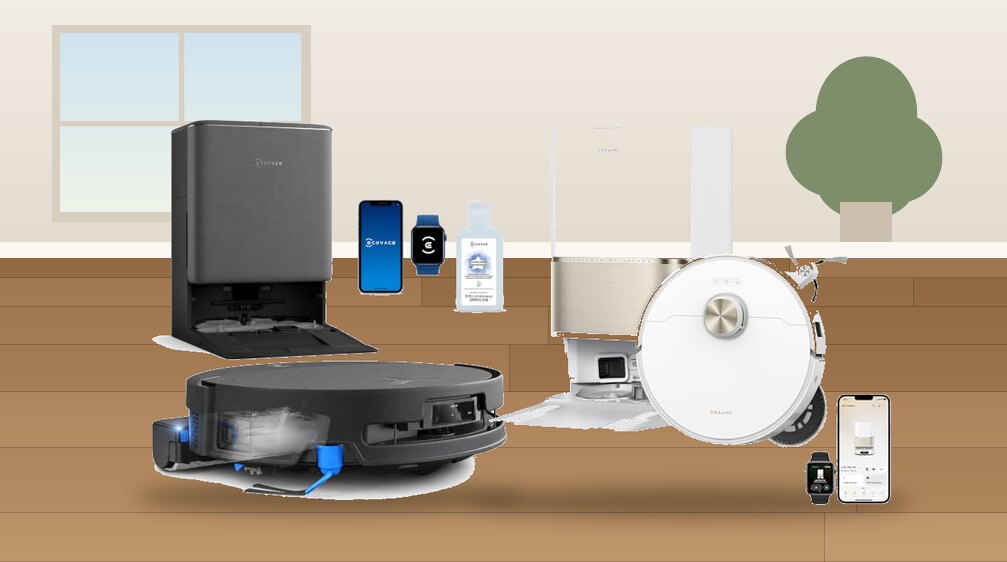
Robot vacuums can pick up the dust, crumbs and pet hair that build up on wood floors every day, but the wrong one can also leave too much water behind or drag a wet mop across your rugs. The best robot vacuum for wood floors should pick up fine debris without scattering it, mop with only a light film of water, lift its mop when it reaches a rug and map your home so you can control where it goes. It should handle both hardwood and laminate, since both can swell or cloud when water sits on them.
We compared 5 robot vacuums across different price ranges and home types to help you find the right one for your floors.
Our top 3 robot vacuums for wood floors


See how all 5 robot vacuums compare in our side-by-side comparison chart ↓
The best robot vacuum for wood floors, by need
- Best overall: Ecovacs Deebot T90 Pro Omni The highest dried-stain mopping score of our picks, only 0.35 g of water left behind in testing, and a roller mop that lifts 15 mm over rugs.
- Best bagless: Ecovacs Deebot X12 OmniCyclone A bagless dock, a self-washing roller that left 0.3 g of water in testing, 100% pet hair pickup and 23 of 24 obstacles avoided.
- Best for wood and rugs: Dreame L60 Ultra PE Left the least water of any pick at 0.25 g and removed 94% of embedded sand from carpet, so it suits wood floors with area rugs.
- Best for raised thresholds: Dreame L50 Ultra Climbing legs rated for 42 mm steps get it over the raised wood transitions found in many older homes.
- Best budget: Roborock Q10 S5+ LiDAR maps, a vibrating mop that left 0.5 g of water, and 96% carpet and pet hair scores for the lowest price here.
Every pick left less water on the floor than average in an independent mopping test, lifts its mop on rugs, and maps your home with LiDAR so you can set water levels and no-mop zones.
The 5 Best Robot Vacuums for Wood Floors
Ecovacs Deebot T90 Pro Omni

- Best dried-stain mopping score of our picks in independent testing
- Left 0.35 g of water behind, about a third of the average
- Picked up 100% of pet hair with zero hair wrap
- Avoided 23 of 24 obstacles
- Small 250 ml onboard dustbin
- Carpet deep cleaning only slightly above average
- Crossed a 32 mm threshold in testing, below its 40 mm rating
- Navigation is only a little better than average
Ecovacs Deebot T90 Pro Omni review
The T90 Pro Omni is our top pick because it solves the main wood floor problem: getting floors clean without leaving them wet. Its 10.6-inch roller mop feeds fresh water as it spins and scrapes dirty water into a separate tank, so it isn't pushing gray water around your hardwood.
Independent testing backs that up. It scored 157 in a dried-stain test against a 108 average, the best mopping result of our five picks, and left just 0.35 g of water on the test floor, about a third of the average. Laminate owners should care most about that number, since water that sits in the seams is what makes boards swell.
It's also a strong vacuum for hard floors. It picked up 100% of pet hair, wrapped none of it on the brush and avoided 23 of 24 obstacles. On rugs, the roller lifts 15 mm.
The trade-offs are a small onboard dustbin, average carpet cleaning and a tested threshold result of 32 mm, so homes with tall wood transitions should look at the Dreame L50 Ultra instead.
Ecovacs Deebot X12 OmniCyclone

- Bagless dock, so there are no dust bags to buy
- Left 0.3 g of water in testing, well under the average
- 100% pet hair pickup and zero hair wrap in testing
- Roller lifts 15 mm and a cover shields it on carpet
- Emptying the bagless bin is dusty
- Below-average carpet deep cleaning and crevice pickup
- Rated for only 24 mm thresholds
- About 3.9 inches tall; got stuck under a low table in one review
Ecovacs Deebot X12 OmniCyclone review
The X12 OmniCyclone is the pick for wood floors if you're tired of paying for dust bags. Its dock collects debris in a bagless bin, and it also washes the roller with hot water, dries it with hot air and cleans the robot's dirty-water tank.
The mop is gentle on wood. In independent testing, it left 0.3 g of water behind against a roughly 1 g average, and its stain score of 112 was slightly above average. In a three-month home test, the low water setting dried floors quickly and left no streaks or roller lines. When it reaches a rug, the roller lifts 15 mm and a cover slides over it.
It's a strong hard-floor vacuum too. It picked up 100% of pet hair, wrapped none of it and avoided 23 of 24 obstacles.
There are drawbacks. The bagless bin is messy to empty, carpet deep cleaning was a little below average and it's rated for only 24 mm thresholds. If you mop sticky kitchen spills often, the T90 Pro Omni scrubs harder.
Dreame L60 Ultra PE

- Left only 0.25 g of water, the lowest of our picks
- Removed 94% of embedded sand from carpet in testing
- 100% pet hair pickup and zero hair wrap
- Avoided 21 of 24 obstacles
- Below-average dried-stain mopping because it uses little water
- Failed a 25 mm threshold in testing
- Mop lifts only 10.5 mm on rugs
- Small onboard dustbin
Dreame L60 Ultra PE review
The L60 Ultra PE is the best choice for wood floors with area rugs. It left the least water of our five picks in independent testing, just 0.25 g on its low setting and 0.30 g on high, so boards are dry within moments of a pass.
Rugs are where it pulls ahead. It removed 94% of embedded sand from carpet, the second-best score among nearly 200 robots in that test, and picked up 100% of flattened pet hair with no hair wrap. It also avoided 21 of 24 obstacles. Its mop pads lift 10.5 mm on carpet, which suits flat-weave and low-pile rugs; for thicker rugs, set them to vacuum only in the app.
The low water output has a downside. Its dried-stain score of 85 was below average, so sticky kitchen spills may need a second pass. It also failed a 25 mm threshold in testing, so check your doorways.
If most of your home is bare wood and you mop messes often, the T90 Pro Omni is the better fit.
Dreame L50 Ultra
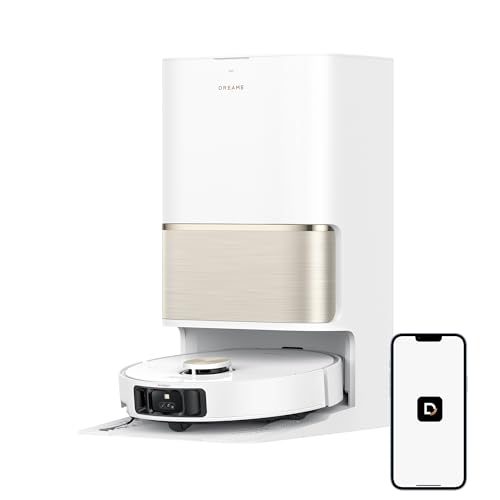
- Climbing legs rated for 42 mm single steps
- Left 0.35 g of water, about a third of the average
- Picked up 100% of pet hair from carpet in testing
- Removed 90% of embedded sand from carpet
- Weakest battery coverage of our picks
- Mopping was below average on the lowest water setting
- Mop lifts only 10.5 mm on rugs
- Top-end pricing for an older model
Dreame L50 Ultra review
The L50 Ultra is for homes where the robot's biggest enemy isn't dirt but the raised strip between rooms. Many older houses have wood saddles or thresholds that stand an inch or more off the floor. Dreame's ProLeap legs push the body up and over, and the maker rates it for 42 mm single steps and two-tier steps up to 2.65 inches.
It's gentle with water. In independent testing, it left 0.35 g behind against a 1.01 g average, and its overall mopping score was above average. The one weak spot was the lowest water setting, which struggled on dried stains, so use the middle setting on sealed hardwood and save the lowest for laminate.
It's a strong vacuum as well. It picked up 100% of flattened pet hair, removed 90% of embedded sand from carpet and avoided 20 of 24 obstacles. Its magnetic mop pads can stay in the dock for rug-only runs.
Battery is the catch. It covered only about 823 sq ft per charge in testing, so large homes will see it stop to recharge. If your floors are level, the T90 Pro Omni lasts longer per charge.
Roborock Q10 S5+

- Lowest price of our picks
- Left 0.5 g of water, about half the average
- 96% carpet deep clean and 96% pet hair pickup in testing
- Zero hair wrap and above-average battery coverage
- Poor obstacle avoidance: 6 of 24 objects
- Dock only empties dust; it doesn’t wash or dry the mop
- Mop lifts just 8 mm, so thicker rugs need no-mop zones
- More early failure reports than usual
Roborock Q10 S5+ review
The Q10 S5+ is the budget pick because it keeps the features wood floors need and drops the ones they don't. It maps your home with a LiDAR turret, so you can set the mopping level for each room and draw no-mop zones around rugs. Its vibrating mop pad left only 0.5 g of water in independent testing, about half the average, and its stain score of 103 beat the 93 average.
It vacuums better than its price suggests. It removed 96% of embedded sand from carpet, tied for the best score in that test, and picked up 96% of pet hair with no hair wrap. It also covered about 1,243 sq ft per charge.
The savings show elsewhere. Its dock empties the dustbin but doesn't wash or dry the mop, so rinse and dry the pad by hand after mopping. Obstacle avoidance was poor at 6 of 24 objects, so pick up cables and socks first. The reviewer also saw more early failure reports than usual.
If you want a dock that cares for the mop, step up to the L60 Ultra PE.
Robot vacuums for wood floors compared
|
Best overall
Ecovacs T90 Pro Omni
|
Best bagless
Ecovacs X12 OmniCyclone
|
Best for wood and rugs
Dreame L60 Ultra PE
|
Best for raised thresholds
Dreame L50 Ultra
|
Best budget
Roborock Q10 S5+
|
|
|---|---|---|---|---|---|
|
|
|
|
|
|
|
| Water left on floor (test) | 0.35 g | 0.3 g | 0.25 g | 0.35 g | 0.5 g |
| Mop type | Roller | Roller | Spinning pads | Spinning pads | Vibrating pad |
| Mop lift on rugs | 15 mm | 15 mm | 10.5 mm | 10.5 mm | 8 mm |
| Dock washes and dries mop | 1 | 1 | 1 | 1 | – |
| Bagless dock | – | 1 | – | – | – |
| Pet hair pickup (test) | 100% | 100% | 100% | 100% | 96% |
| Obstacles avoided (test) | 23 of 24 | 23 of 24 | 21 of 24 | 20 of 24 | 6 of 24 |
| Single threshold | 40 mm | 24 mm | Failed 25 mm test | 42 mm | Not listed |
| Wood floor fit | 5 | 5 | 4 | 4 | 4 |
| Current price | $799.99 | $899.99 | $899.99 | $802.33 | $549.99 |
| Read review | Read review | Read review | Read review | Read review |
Robot vacuums for wood floors compared


Prices and availability change often. Test results come from the independent sources named in How We Picked and Tested. Threshold ratings come from maker listings. Star ratings are our editorial judgment, not our own lab tests.
What wood floors need from a robot vacuum
Wood looks tough, but it reacts to water and grit in ways tile doesn't. A good robot for hardwood or laminate has to handle three things.
Light water, not wet mopping. Sealed hardwood tolerates a damp wipe, but water that sits on the surface works into gaps between boards and can cause cupping or a cloudy finish over time. Laminate is even more sensitive, because its core is pressed wood fiber that swells at the seams. That's why every pick here left less water behind than average in independent testing. If your robot leaves streaks of standing water, turn the water level down.
Fine debris without scratches. Sand and grit act like sandpaper under shoes and chair legs. Daily robot runs keep that grit from building up. Rubber or rubber-and-bristle main brushes handle fine dust on smooth floors well, and they resist tangles from long hair.
Rugs that stay dry. Most wood floors have at least one area rug. A robot should lift its mop when it detects carpet, or leave its pads in the dock for rug runs. Our picks lift between 8 and 15 mm, which suits flat-weave and low-pile rugs. If your rugs are deep and plush, a robot built for thick carpet and tall rug edges will do better.
Hardwood and laminate need the same robot, but laminate deserves the lowest water setting and a mop that never sits on the floor while wet. For more on how floating floors react to moisture and suction, see our guide to vacuums for laminate floating floors.
How to choose a robot vacuum for wood floors
This matters more than suction on wood. Too much water is the main way a robot mop harms hardwood or laminate.
Most wood floors have area rugs, and a wet mop dragged over them leaves damp spots and odors.
You’ll want to keep the mop away from rugs, pet bowls and any older boards with worn finish.
A damp pad left on the robot can sour and drip onto the floor near the dock.
Older homes often have raised wood saddles between rooms that block ordinary robots.
Wood floors are often open-plan, but cables and pet toys still trap robots.
Robot vacuum or electric mop for wood floors?
A robot vacuum with a mop is built for daily upkeep. It removes dust, pet hair and light footprints before they build up, and it runs while you're out. What it can't do well is a deep clean of sticky spills, dried food or the edges right along baseboards.
That's why many wood floor owners pair a robot with a hand-held floor cleaner for weekly or spot jobs. Our picks for the best electric mops for hardwood floors use controlled water and soft pads that are safe on sealed wood. If you also have carpet in bedrooms and want one full-size vacuum for everything, see our guide to the best vacuum for hardwood and carpet.
Whatever you use, avoid steam on wood. Most flooring makers warn against it, because heat and moisture can break down the finish and swell the boards.
How to set up a robot vacuum for wood floors
-
Start on the lowest water level
Run one mopping pass on low and check the floor a minute later. It should look dry or just barely damp. Raise the level one step only if marks remain.
-
Set laminate rooms lower than hardwood
Use per-room settings so laminate gets the lightest water and sealed hardwood can take a little more.
-
Mark rugs and pet areas
Draw no-mop zones around rugs the robot doesn’t detect, and no-go zones around water bowls and fringe.
-
Use the right cleaner or plain water
Only use the floor solution your robot’s maker approves. Never add vinegar, oil soaps or wax to the tank.
-
Vacuum before you mop
Choose vacuum-then-mop mode so grit is picked up before the pad passes over it.
-
Keep the mop clean and dry
Let the dock wash and dry the mop after every run. On models without that, rinse the pad and let it dry off the floor.
Will a robot vacuum scratch hardwood floors?
A working robot vacuum is very unlikely to scratch sealed hardwood or laminate. Its wheels are rubber, its brushes are soft and it weighs only a few pounds. Scratches usually come from grit that gets trapped and dragged, so the fix is the same as for any vacuum: keep the brush clean, replace worn side brushes and empty the bin before it overflows.
Regular runs actually help protect wood. Grit tracked in on shoes is what dulls a finish over time, and a robot that clears it daily cuts that wear. For a full care routine, including what cleaners to use and what to avoid, read our step-by-step guide on how to clean hardwood floors.
Wood floor robot vacuum FAQs
What is the best robot vacuum for wood floors?
The Ecovacs Deebot T90 Pro Omni for most homes. It had the best mopping score of our picks, left only 0.35 g of water in testing and lifts its roller 15 mm on rugs. If your wood floors have several area rugs, the Dreame L60 Ultra PE is the better fit.
Are robot mops safe for hardwood floors?
Yes, on sealed hardwood, as long as the robot uses a light amount of water. Pick a model with adjustable water levels, start on low and check that the floor dries within a minute or two. Unsealed, waxed or oiled wood should be vacuumed only.
Can I use a robot vacuum on laminate floors?
Yes. Laminate is easy for robots to vacuum. For mopping, use the lowest water level, because water that seeps into the seams can make the boards swell.
Is it safe to use steam on wood floors?
No. Steam pushes heat and moisture into the finish and the seams. Read our guide to the risks of steam cleaning wood floors for safer options.
Do robot vacuums scratch wood floors?
Rarely. Robots have rubber wheels and soft brushes. Scratches usually come from trapped grit, so clean the brushes and replace worn side brushes on schedule.
Should I choose a roller mop or spinning pads for wood?
Both work. Roller mops like the Ecovacs picks rinse themselves with fresh water as they clean, which helps with sticky spots. Spinning pads like the Dreame picks can leave even less water. In testing, all five of our picks left less water than average.
Is the same robot good for wood and tile?
Mostly, yes. Tile can take more water and benefits from extra scrubbing on grout. If most of your home is tile, see our picks for the best robot vacuum for tile floors.
How often should a robot vacuum run on wood floors?
Vacuum daily in busy rooms and every few days elsewhere. Mop once or twice a week on low water, more often in kitchens and entryways.
Which robot vacuum should you buy for wood floors?
- Best overall: Ecovacs Deebot T90 Pro Omni
- Best bagless: Ecovacs Deebot X12 OmniCyclone
- Best for wood and rugs: Dreame L60 Ultra PE
- Best for raised thresholds: Dreame L50 Ultra
- Best budget: Roborock Q10 S5+
On wood, water control comes first, then rug handling, then suction. The Ecovacs T90 Pro Omni balances strong mopping with a nearly dry finish. Choose the X12 OmniCyclone to skip dust bags, the L60 Ultra PE for homes with rugs, the L50 Ultra for tall thresholds and the Q10 S5+ for the lowest price.
How We Picked and Tested
We started with what this search is really asking: which robot can keep hardwood and laminate clean without leaving water on the boards or soaking the rugs that sit on them. Before looking at any model, we set four pass/fail rules, and all five picks meet all four. First, light water: each one left less water on the floor than average in Vacuum Wars’ standardized mopping test, between 0.25 g and 0.5 g against an average of about 1 g. Second, dry rugs: each lifts its mop automatically when it detects carpet, by 8 to 15 mm. Third, control: each maps your home with LiDAR and lets you set water levels and no-go or no-mop zones in its app. Fourth, proof: each has published, standardized independent test results for mopping, pet hair and obstacle avoidance.
Those rules ruled out several well-known robots. The Dreame X60 Max Ultra Complete and L60 Pro Ultra are strong vacuums, but both left more water than average in the same test (1.4 g and 1.6 g). The Roborock Qrevo S Pro mops well but also left above-average water and picked up only 43% of pet hair. The MOVA P10 Pro Ultra Gen 2 avoided just 4 of 24 obstacles, and a hands-on review of the Narwal Freo 20 found it repeatedly stuck and re-cleaning the same spots. RTINGS’ top robot for hardwood, the Roborock Saros 10R, had no Amazon listing when we checked in October 2026, so we left it out. Awards reflect each robot’s real strength: the T90 Pro Omni had the best stain score with low water, the X12 OmniCyclone is the only pick with a bagless dock, the L60 Ultra PE left the least water and had the best carpet score, the L50 Ultra has climbing legs, and the Q10 S5+ was the lowest-priced qualifying robot.
For performance, we relied on independent testing rather than marketing. Our main source was Vacuum Wars, which runs the same dried-stain mopping test, water residue measurement, embedded-sand carpet test, pet hair test, seven-inch hair-wrap test and 24-object obstacle course on every robot; all water, mopping, carpet, pet hair and obstacle figures on this page come from its reviews of these five models. We cross-checked hard floor rankings with RTINGS, whose lab ranks robots specifically for hardwood pickup. For real-home use on hard floors, we read BGR‘s hands-on X12 OmniCyclone review, plus Vacuum Wars’ three-month X12 home test and Tom’s Guide’s reviews of the Narwal Freo 20 and Roborock Qrevo 2 Pro.
We checked every spec we mention, including mop lift heights, mop types, dock features, threshold ratings and navigation type, against the makers’ own listings from Ecovacs, Dreame and Roborock and the current Amazon listings in October 2026. Threshold ratings are maker claims; water, mopping and obstacle results are independent test results and are labeled as such. Lab water tests use a standard test floor, not your exact hardwood or laminate, so start on the lowest water setting at home. We did not test these robots ourselves, and we point out each one’s limits so you can match it to your floors.
Why trust CleanTheFloor?
CleanTheFloor publishes practical floor-care advice and buying guides for homeowners and pet owners. We base our picks on published test results and verified specifications rather than marketing claims, and we point out each product's drawbacks.