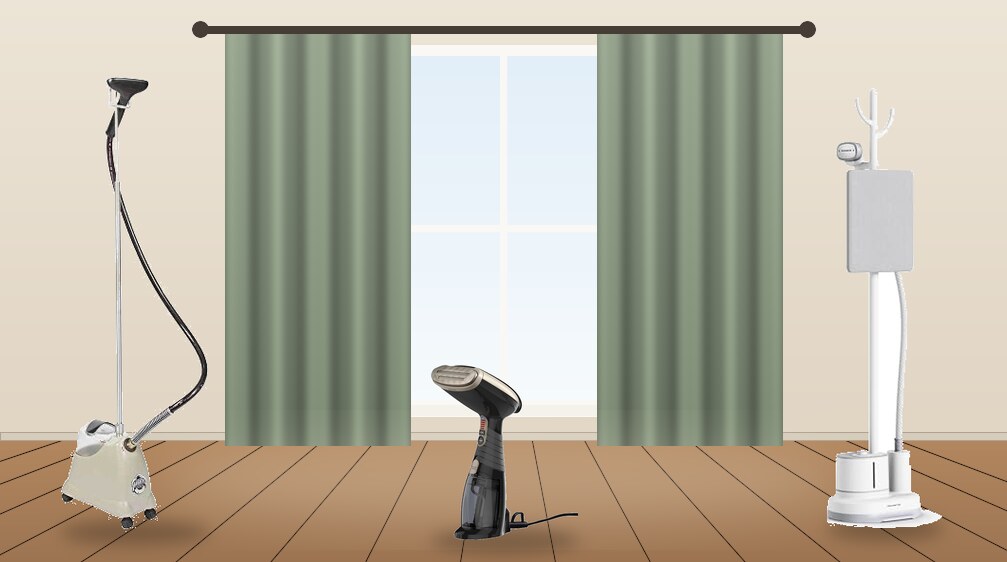
Curtains trap dust, cooking smells and pet odor, and they wrinkle the moment you hang them. Taking them down to wash is a chore, and many drapes are dry-clean only. A steamer fixes both problems while the panels stay on the rod. The hard part is reach and stamina: floor-length drapes need a long hose, a big tank and steady steam, not a travel steamer that runs dry in ten minutes. For most homes, the best curtain steam cleaner is the Jiffy J-2000, a pro-style upright that steams for up to 90 minutes per fill. Below, we match five steamers to different curtains and homes.
Our top 3 curtain steamers


See how all 5 curtain steamers compare in our side-by-side comparison chart ↓
The 5 Best Curtain Steam Cleaners
Jiffy J-2000

- Up to 90 minutes of steam from a 3/4-gallon (2.8 L) tank
- Refill while it’s running for nonstop steaming
- Steady, heavy steam that relaxes thick drapes and linings
- Made in the USA with a 3-year warranty
- Costs much more than home steamers
- Takes 1 to 2 minutes to heat up
- 5.5-foot hose may not reach the top of very tall drapes without a step stool
- No steam-level settings
Jiffy J-2000 review
The J-2000 earns the top spot because curtains are a big job, and it's the only pick here built for big jobs. Its 3/4-gallon tank is rated for about 90 minutes of steam, more than double most home uprights. That's enough to do every window in an average home on one fill, and you can top it up mid-session.
Steam output is strong and constant. That matters on heavy lined drapes, where a weak steamer only wets the surface while the creases stay put. Jiffy builds it with a brass heating element and backs it with a 3-year warranty, and many owners keep these steamers for a decade or more.
There are trade-offs. It heats in about one to two minutes, slower than a home model. There are no steam settings, so test delicate sheers first. And owners on the maker's site note that the 5.5-foot hose doesn't quite reach the top of 84-inch panels, so plan on a step stool for tall windows.
Buy it if you have lots of curtains, heavy drapes or plan to steam often. If you only touch up one or two panels a season, it's more machine than you need.
Rowenta Home Steam IS3250

- Ready to steam in about 45 seconds
- Three steam levels for sheers, cotton and heavier panels
- 47-ounce tank you can refill while steaming
- Built-in vertical board for panels you take down
- About 35 minutes of steam per fill
- Less steam output than the Jiffy on thick drapes
- Lighter build than pro-style steamers
Rowenta Home Steam IS3250 review
The Rowenta Home Steam is the better fit if you have a few windows and want something that heats fast and gets out of the way. It's ready in about 45 seconds, and Rowenta rates it at up to 38 grams of steam per minute, which is plenty for cotton, linen and polyester panels.
The three steam levels are the reason it suits curtains so well. Sheers and lightweight voiles can water-spot or stretch under heavy steam, so the low setting matters. Turn it up for lined cotton drapes. The 47-ounce tank gives about 35 minutes of steam, enough for a bedroom and living room, and you can refill it without shutting down.
It also has a vertical board, handy when you take a valance or short panel down for a crisper finish. When you're done, it's slim enough to hang or tuck into a closet. Editors at several shopping guides recommend it for people who refresh curtains and bedding regularly.
The limits show on big jobs. Thirty-five minutes won't cover a whole house of floor-length drapes, and heavy blackout or velvet panels take more passes than with the Jiffy.
Conair Turbo ExtremeSteam

- 1875 watts, among the most powerful handhelds sold
- Ready in about 35 seconds
- Designed to avoid spitting and wet spots
- 9-foot cord and three attachments, including a fabric brush
- 7.3-ounce tank lasts up to 20 minutes
- Holding it overhead gets tiring on tall drapes
- Too small for a whole house of curtains
Conair Turbo ExtremeSteam review
For a quick refresh, the Conair Turbo ExtremeSteam beats wheeling out an upright. It's one of the most powerful handhelds sold, at 1875 watts, and it's ready in about 35 seconds. Conair designs it to deliver dry steam without spitting, the main worry when you're steaming expensive panels in place.
Its 9-foot cord helps more than you might think. Curtains hang near walls and furniture, and a short cord forces you to use an extension. The included fabric brush helps loosen dust from textured weaves, and the heated plate can press a crisp hem on panels you lay flat.
Tank size is the trade-off. The 7.3-ounce tank lasts up to 20 minutes, about two or three standard panels, so it's not a whole-house tool. Holding a handheld over your head also gets tiring fast, so use a step stool for the top of tall drapes instead of reaching.
It also turns up on several editor shortlists of top handheld steamers. Get it if you want one steamer for clothes that also handles curtain touch-ups. If you're steaming more than four or five panels at a time, an upright will be faster.
SALAV GS18-DJ

- 1.8-liter tank for about 60 minutes of steam
- Heats in about 45 seconds
- Rolling wheels make moving between rooms easy
- Lowest price among the uprights here
- Single steam level, no gentle setting for sheers
- Mostly plastic build and a 1-year warranty
- Less steam force than pro models on thick drapes
SALAV GS18-DJ review
The SALAV GS18-DJ is the budget pick for people with a lot of curtain to cover. Its 1.8-liter tank runs for about 60 minutes, nearly twice the Rowenta's rated time and far beyond any handheld. That makes it a sensible choice for a home with several large windows, sliding-door drapes or long panels in a living room.
It heats in about 45 seconds and rolls on wheels, so moving between rooms is easy. The aluminum pole telescopes down for storage, and SALAV includes a descaler packet to fight mineral buildup, which helps if your tap water is hard. SALAV lists curtains among the fabrics it's made for.
The savings show in the details. There's one steam level, so you can't turn it down for delicate sheers, and you'll need to keep the head moving to avoid damp spots. The build is mostly plastic, with a 1-year warranty compared with the Jiffy's three. Thick velvet or blackout drapes will also take more passes.
Buy it if you want a big tank at a modest price and mostly steam cotton, linen or polyester curtains.
McCulloch MC1275

- Pressurized steam for odors, grime and dust
- Steam hose over 9 feet long reaches high curtain tops
- Up to 45 minutes of steam from a 48-ounce tank
- Doubles as a whole-home steam cleaner with 18 accessories
- Takes up to 8 minutes to heat
- Wetter steam can water-spot delicate fabrics
- No dedicated garment steaming head
- Can’t be refilled until it cools down
McCulloch MC1275 review
The McCulloch MC1275 is a different kind of tool. A garment steamer makes low-pressure steam that relaxes wrinkles. This is a pressurized canister steam cleaner, so the steam comes out hotter and with more force. On curtains, that helps with musty smells, smoke odor, grime along the bottom hem and dust in heavy fabric.
Reach is a real advantage. The steam hose is over 9 feet long and the power cord is 15.7 feet, so you can treat the top of a tall drape without climbing. The 48-ounce tank gives up to 45 minutes of steam, and the lockable trigger saves your hand on long sessions.
It isn't built for delicate fabric, though. Pressurized steam is wetter, so wrap a tool in a microfiber cloth, hold it a few inches away and keep it moving. Skip it on silk, velvet and sheers. Heat-up takes up to 8 minutes, and the boiler can't be refilled until it cools.
Choose it if you also want a steam cleaner for tile, grout and the car, and your curtains are sturdy cotton, linen or synthetic blends that need more than a wrinkle touch-up.
Curtain steamers compared
|
Best overall
Jiffy J-2000
|
Best for small homes
Rowenta Home Steam
|
Best handheld
Conair Turbo ExtremeSteam
|
Best budget
SALAV GS18-DJ
|
Best for deep cleaning
McCulloch MC1275
|
|
|---|---|---|---|---|---|
|
|
|
|
|
|
|
| Type | Pro upright | Upright | Handheld | Upright | Canister |
| Water tank | 2.8 L | 47 oz | 7.3 oz | 1.8 L | 48 oz |
| Steam time (rated) | 90 min | 35 min | 20 min | 60 min | 45 min |
| Heat-up | 1-2 min | 45 sec | 35 sec | 45 sec | Up to 8 min |
| Steam levels | – | 1 | 1 | – | – |
| Safe for sheers | 2 | 3 | 3 | 2 | 1 |
| Heavy drapes | 3 | 2 | 2 | 2 | 3 |
| Current price | $239.00 | $99.95 | $67.99 | $86.99 | $168.99 |
| Read review | Read review | Read review | Read review | Read review |
Curtain steamers compared


Prices and availability change often. Tank sizes, steam times and heat-up times are maker ratings. Star ratings are our editorial judgment based on specs and published reviews, not our own tests.
Can you steam clean curtains while they're hanging?
Yes, and for most curtains it's the easiest way to keep them fresh. Steam relaxes creases, kills odors trapped in the fibers and loosens dust so you can brush or vacuum it away. Because the panels stay on the rod, gravity pulls the fabric straight as it dries, which often leaves a smoother finish than washing and rehanging.
Steaming isn't the same as washing, though. It won't remove set-in stains, nicotine yellowing or heavy grease from a kitchen window. For those, follow the care label: machine wash, hand wash or take them to a dry cleaner. Think of steam as the step you do every month or two between deep cleans.
Which curtain fabrics are safe to steam?
Most are. Cotton, linen, polyester and blends handle steam well, and so do most lined drapes. Some fabrics need more care:
- Sheers and voiles: use the lowest steam setting and keep the head an inch or two away, since heavy steam can stretch or spot them.
- Silk: test a hidden corner first. Silk can water-spot, so use light steam from the back side.
- Velvet: steam from the back so you don't crush the pile, and never press the steam head against the front.
- Blackout curtains: steam the fabric side only. Heat can damage the foam or acrylic coating on the back.
- Dry-clean-only drapes: light steaming to refresh is usually fine, but check the label. Some makers warn against any moisture.
When in doubt, steam a small spot near the bottom hem on the back side and let it dry before doing the whole panel.
How to choose a steamer for curtains
A single floor-length panel can take five minutes or more. Small tanks mean constant refills.
The top of the curtain is where wrinkles from packaging and rings show most.
Sheers, silk and velvet need gentler steam than cotton or linen.
Spitting water leaves spots that are hard to fix on hanging fabric.
Garment steamers remove wrinkles gently. Pressurized steam cleaners clean deeper but run wetter.
Mineral buildup is the most common reason steamers fail.
Garment steamer vs. steam cleaner for curtains
A garment steamer heats water to make low-pressure steam that flows out of a wide head. It's gentle, dry and made for fabric, so it's the right choice for wrinkles, light odors and regular refreshes. Upright models like the Jiffy, Rowenta and SALAV add big tanks for long sessions, and handhelds like the Conair trade tank size for convenience.
A steam cleaner, like the McCulloch, builds pressure inside a sealed boiler. The steam is hotter and comes out with more force, which helps with grime, smoke smell and dust deep in heavy fabric. The downside is moisture. Pressurized steam is wetter, so it's riskier on delicate curtains and needs a cloth-covered tool and steady movement.
Most people only need a garment steamer. Pick a steam cleaner if your curtains are sturdy, your main issue is odor or grime and you'd also use it on tile, grout or upholstery.
How to steam curtains without taking them down
-
Vacuum first
Run a vacuum with a brush tool over each panel to pull off loose dust. Steaming a dusty curtain can turn dust into dirty streaks.
-
Check the label and test a spot
Steam a small area on the back of the bottom hem and let it dry. Look for spots, shrinking or changes in texture.
-
Fill with the right water
Use the water your steamer’s manual recommends. In hard-water areas, distilled water or regular descaling helps prevent spitting and buildup.
-
Work from top to bottom
Start at the top of each panel and move down in slow, vertical strokes. Use a step stool to reach the top safely instead of stretching.
-
Keep the head moving
Hold the steam head just off the fabric, or lightly touching sturdy fabrics. Gently pull the hem taut with your free hand, keeping fingers away from the steam.
-
Let the panels dry before closing
Leave curtains open and the room ventilated for about 30 minutes so fabric dries straight and no moisture gets trapped in folds.
Curtain steam cleaner FAQs
What is the best steam cleaner for curtains?
For most homes, the Jiffy J-2000. Its 3/4-gallon tank steams for up to 90 minutes, enough for every window in an average home. For a few windows, the Rowenta Home Steam IS3250 is smaller and heats faster.
Is a handheld steamer good enough for curtains?
For one or two panels, yes. A strong handheld like the Conair Turbo ExtremeSteam works well, but its small tank lasts about 20 minutes, so an upright is faster for a whole room.
Does steaming curtains kill dust mites and germs?
Makers claim hot steam kills dust mites and many bacteria, and higher-temperature steam cleaners do more than garment steamers. Steaming freshens fabric well, but it’s not a certified disinfecting method.
Can I steam blackout curtains?
Yes, on the fabric side only, with low to medium steam. Heat on the coated back can damage the blackout layer.
How often should I steam my curtains?
Every one to three months works for most homes. Kitchen curtains and homes with pets or smokers may need it monthly.
Will steaming shrink my curtains?
Light steaming rarely shrinks curtains because you aren’t soaking or tumble-drying them. Natural fibers like linen can tighten slightly if you oversaturate them, so keep the head moving.
Can I use a carpet cleaner or steam mop on curtains?
No. Carpet cleaners soak fabric with water, and steam mops are built for floors. Use a garment steamer, or a canister steam cleaner with a cloth-covered tool.
Which curtain steamer should you buy?
- Best overall: Jiffy J-2000
- Best for small homes: Rowenta Home Steam IS3250
- Best handheld: Conair Turbo ExtremeSteam
- Best budget: SALAV GS18-DJ
- Best for deep cleaning: McCulloch MC1275
Get the Jiffy J-2000 if you have lots of curtains or heavy drapes and want a steamer that lasts. The Rowenta Home Steam suits apartments and smaller homes with a few windows and delicate sheers. Choose the Conair handheld for quick touch-ups, the SALAV GS18-DJ for a big tank on a budget, and the McCulloch MC1275 when odors or grime call for a true steam cleaner.
How We Picked and Tested
Our recommendations are based on verified manufacturer specifications, published buying guides and owner feedback. We checked specs and descriptions on the Jiffy J-2000 product page, compared picks against roundups such as The Gadgeteer, which gathers recommendations from Wirecutter, Good Housekeeping and The Spruce, and confirmed tank sizes, steam times and heat-up times on the current Amazon listings from Rowenta, Conair, SALAV and McCulloch.
Curtains are a different job from a shirt or dress. Panels are long, often lined, and they hang high on a rod, so we put the most weight on steam time per fill, reach and steam control for delicate fabrics. We also included one pressurized steam cleaner because some shoppers need to remove odors and grime, not just wrinkles.
Each product got a distinct role based on where its specs and published feedback were strongest. Steam times, tank sizes, heat-up times and wattage are manufacturer ratings. We did not test these steamers ourselves, and the star ratings in the comparison chart are our editorial judgment.
Why trust CleanTheFloor?
CleanTheFloor publishes practical home-cleaning advice and buying guides for homeowners and pet owners. We base our picks on published reviews and verified specifications rather than marketing claims, and we point out each product's drawbacks.