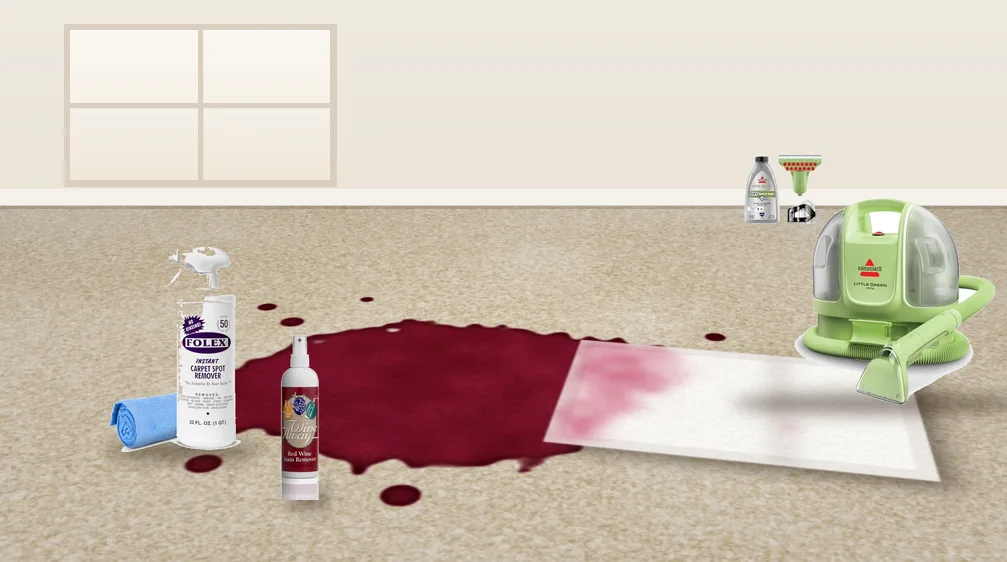
To remove red wine from carpet, blot up as much wine as you can with a white cloth, pour a little cold water or club soda on the spot, and keep blotting from the outside in until no more color transfers. Then treat what's left with a mild mix of clear dish soap and cool water, rinse with plain water, and blot dry. Never rub, and never use hot water, because heat and scrubbing push the wine deeper and help it set.
That's the short version of how to remove red wine from carpet. The rest of this guide covers what to do in the first five minutes, which home remedies actually work (baking soda, salt, dish soap and vinegar, hydrogen peroxide), how to rescue a dried stain, and what changes on wool, white and synthetic carpet. Every step is based on guidance from carpet industry and university sources, not on cleaning myths.
How to get red wine out of carpet in 5 steps
- 1. Blot right away Press a white cloth or paper towel on the spill and lift. Repeat with clean sections until the cloth comes up almost dry. Don’t rub.
- 2. Dilute with cold water Pour a few tablespoons of cold water or club soda on the spot and blot again. Diluting the wine is what pulls the color out.
- 3. Treat with mild soap Mix 1/4 teaspoon of clear dish soap in 1 cup of cool water. Apply a little, wait a few minutes, then blot from the edge toward the center.
- 4. Rinse and blot dry Blot with plain water to remove the soap, then press a thick stack of white paper towels on the spot under something heavy.
- 5. Escalate only if needed For a pink shadow, use a red wine remover or, on light synthetic carpet only, 3% hydrogen peroxide after a spot test.
Based on guidance from the Carpet and Rug Institute, University of Georgia Extension and Consumer Reports.
Why Red Wine Stains Carpet So Fast
Red wine gets its color from natural plant pigments called anthocyanins, plus tannins from the grape skins. Both are small, water-soluble molecules, so they soak into carpet fibers within seconds, and they bond more tightly as they dry. Two things make the stain much harder to remove:
- Time. Wet wine is still mostly water, so it rinses out. Once it dries, the pigment is locked onto the fiber and needs a cleaner to loosen it.
- Heat. Hot water, steam and hair dryers help tannin stains set. University of Georgia Extension's stain guide tells you to start with cool water on wine for this reason.
The pigments also react to pH. In alkaline conditions, like a heavy dose of baking soda or ammonia, red wine can shift toward blue or gray. That's a color change, not a cleaner carpet, and it's one reason some popular remedies need care, as you will see below.
What to Do in the First 5 Minutes
The first few minutes decide whether you're dealing with a quick cleanup or a stubborn stain. Do these things in order:
- Stop the spread. Pick up the glass and blot any splashes on furniture or walls first if they're running onto the carpet.
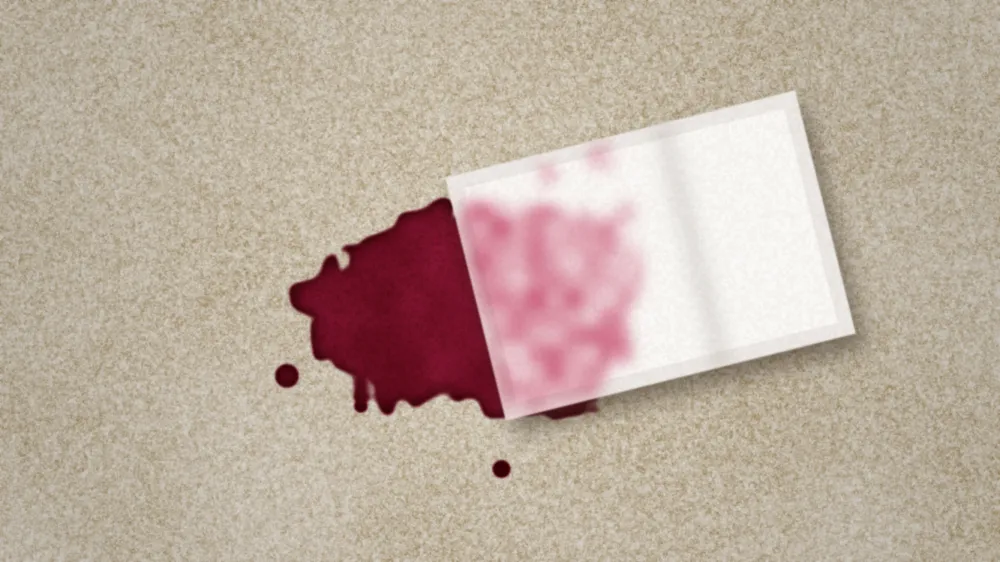
- Blot, don't rub. Fold a white cloth or plain white paper towel and press straight down on the wine. Lift, move to a clean section, and press again. The Carpet and Rug Institute (CRI) warns against scrubbing or brushing, because it frays the pile and spreads the stain.
- Work from the outside in. Start at the edge of the spill and move toward the center, so you don't push wine into clean carpet.
- Use white only. Printed paper towels and colored rags can transfer dye onto a wet carpet.
- Don't reach for white wine. Pouring white wine on red is an old trick, but Consumer Reports notes that it can leave a brown stain that's very hard to remove.
You'll go through cloths fast on a big spill, so it helps to keep a stack of plain white cotton towels in the house. They're absorbent, reusable and safe to use with any of the methods below.
Utopia Towels White Cotton Bar Mop Towels (12 Pack)

How to Remove Fresh Red Wine From Carpet, Step by Step
-
Blot up the excess
Press a folded white cloth on the spill and lift straight up. Keep switching to a dry section until the cloth shows only a faint pink tint. This step removes more wine than anything else you’ll do.
-
Pour on a little cold water or club soda
Add 2 to 3 tablespoons of cold water or club soda to the spot. You want to dilute the wine, not flood the carpet. Too much liquid soaks through to the pad, where the stain can wick back up later.
-
Blot again from the edges in
Blot the diluted wine with a clean cloth. Repeat the water and blotting two or three times. Each round should bring up lighter pink.
-
Apply a mild dish soap solution
Mix 1/4 teaspoon of clear, bleach-free dish soap in 1 cup of cool water. Dampen a white cloth with it and dab it onto the stain. Let it sit 3 to 5 minutes so the soap can loosen the pigment.
-
Blot out the soap and wine
Blot from the outside in until no more color moves to the cloth. If you still see pink, repeat the soap step once more before trying anything stronger.
-
Rinse with plain water
Dab the area with a cloth dampened in clean cool water, then blot. CRI notes that leftover cleaner leaves a sticky residue that attracts dirt, so this rinse matters.
-
Dry it under weight
Lay a thick stack of white paper towels on the spot and set a heavy book in a plastic bag on top. Leave it for a few hours. The towels wick up the last traces of moisture and color.
-
Fluff the pile and vacuum
Once the spot is fully dry, brush the pile gently with your fingers and vacuum to restore the texture.
Most fresh spills come out with water and mild soap alone. If a faint pink shadow is left after you've rinsed and dried the spot, a remover made for wine is the safest next step. Spray it on, wait for the time on the label, blot, and rinse.
Wine Away Red Wine Stain Remover (12 oz)

Home Remedies for Red Wine on Carpet
You probably have everything for these remedies in your kitchen. They don't all work the same way, though, and some can make things worse on the wrong carpet. Here's what each one actually does, so you can pick the right one.
| Remedy | Best for | How it works | Watch out for |
|---|---|---|---|
| Cold water or club soda | Every fresh spill | Dilutes the wine so you can blot it out | Too much liquid soaks the pad |
| Salt | Big, wet spills | Draws up liquid before it spreads | Does nothing on dried stains |
| Baking soda | Fresh spills, odor | Absorbs liquid as a paste | Can turn the stain gray-blue |
| Dish soap and vinegar | Light pink shadows | Loosens and lifts pigment | Must be rinsed out well |
| Hydrogen peroxide and dish soap | Light synthetic carpet | Oxidizes (bleaches) the color | Can lighten dyed carpet |
Always test any remedy on a hidden spot first, such as inside a closet or under a sofa. Wait until it dries and check for color change.
Club Soda vs. Cold Water
Club soda is a popular first step, and University of Georgia Extension's stain guide does suggest it for wine on carpet. Its real job is the same as cold water: diluting the wine so you can blot it out. If you have club soda handy, use it. If you don't, plain cold water works just as well. Don't wait to find a bottle while the wine soaks in.
How to Remove Red Wine From Carpet With Baking Soda
Baking soda works best on a wet stain, where it acts as an absorbent paste.
- Blot up as much wine as you can.
- Mix 3 parts baking soda with 1 part cold water to make a thick paste.
- Spread it over the stain and let it dry completely, usually a few hours.
- Vacuum up the dried powder, then blot the spot with cool water to remove any residue.
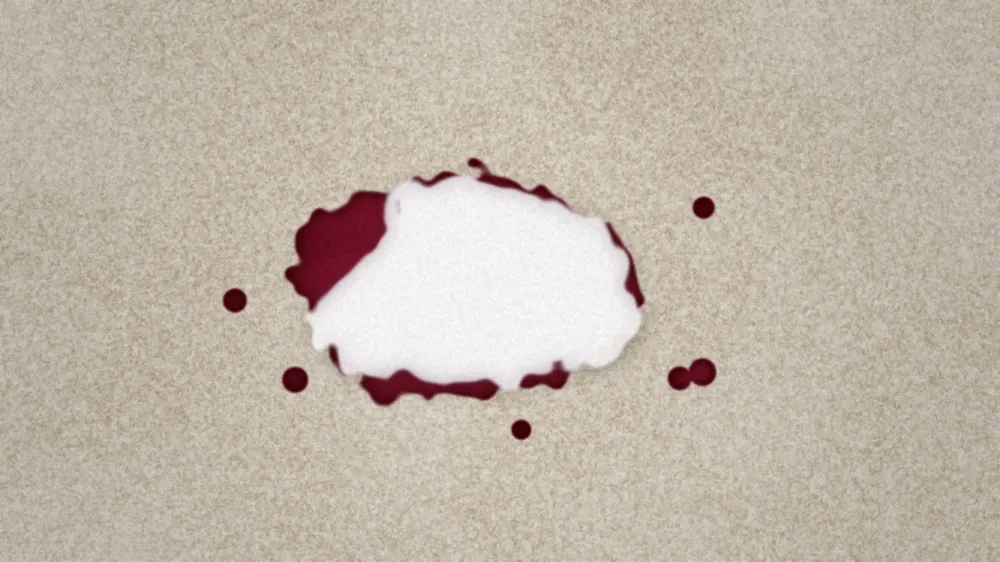
The catch: baking soda is alkaline. On some wines, it turns the stain gray or blue-violet instead of lifting it. If that happens, don't panic. Blot the area with the dish soap and vinegar mix below, which brings the pH back down, then rinse with water. Avoid heavy baking soda use on wool, since wool fibers don't like alkaline products. Baking soda also helps with the sour smell a big spill can leave behind.
How to Remove Red Wine From Carpet With Salt
Salt is an emergency tool, not a stain remover. It soaks up liquid, which helps on a big, wet spill when you can't blot fast enough.
- Blot first, then cover the wet area with a thick layer of table salt.
- Leave it for 5 to 10 minutes. The salt will turn pink as it pulls wine out of the pile.
- Vacuum up all the salt.
- Finish with the cold water and dish soap steps above to remove the remaining color.
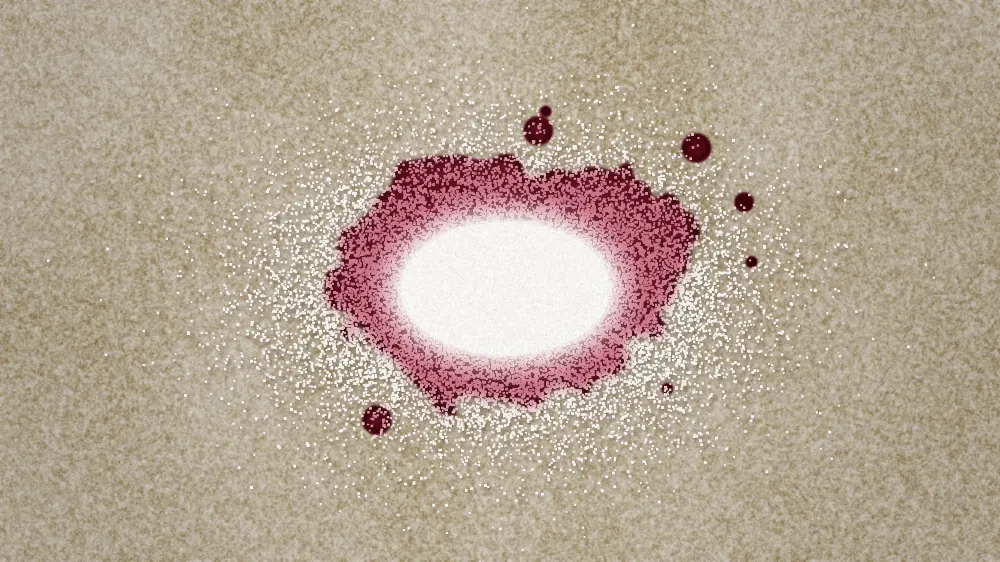
The catch: salt only works while the wine is wet. On a dried stain it does nothing. Make sure you vacuum it all up, because salt left in the pile pulls moisture out of the air and can leave a damp, gritty spot.
Dish Soap and White Vinegar
This is the best home remedy for the pink shadow that's often left after blotting. The soap lifts the pigment, and the mild acid in vinegar helps loosen tannins and keeps the color from shifting.
- Mix 1/4 teaspoon of clear dish soap, 1 tablespoon of white vinegar and 1 cup of cool water.
- Dab it onto the stain with a white cloth. Don't pour.
- Wait 5 minutes, then blot from the outside in.
- Rinse with plain water and blot dry.
Use clear dish soap with no bleach, lotion or moisturizers. Colored soap can tint carpet, and moisturizers leave a film. Don't add more soap than this, because extra soap is hard to rinse out and makes the spot attract dirt.
Hydrogen Peroxide and Dish Soap
Hydrogen peroxide is a mild bleach. It removes wine by breaking down the color, which is also why it can lighten the dye in your carpet. Use it only on white or very light synthetic carpet, and only after a spot test.
- Mix 1 tablespoon of 3% hydrogen peroxide (the brown drugstore bottle) with 1/2 teaspoon of clear dish soap.
- Dab a small amount on the stain. Don't soak it.
- Wait 10 to 15 minutes, then blot.
- Rinse well with cool water and blot dry. Don't leave peroxide in the carpet.
Safety notes: never mix hydrogen peroxide with vinegar in the same container, since the combination forms an irritating acid. Never mix any cleaner with chlorine bleach. Don't use stronger peroxide than 3%.
For coffee, grease and other everyday spills, these spot-cleaning basics work the same way.
How to Remove Dried Red Wine From Carpet
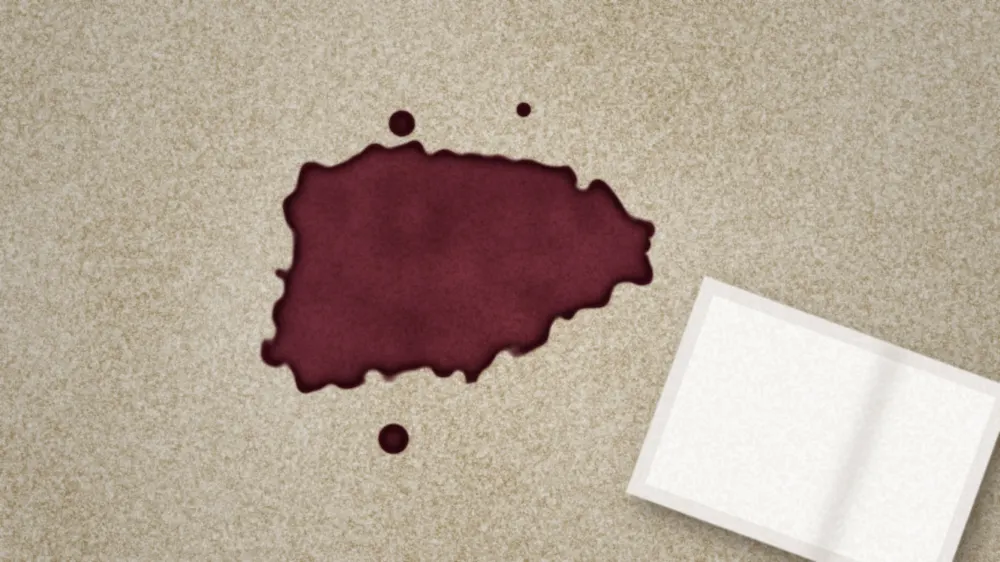
A dried stain takes more patience, but it's rarely hopeless. The trick is to make it wet again so the pigment can move.
- Vacuum the area to remove loose grit.
- Rehydrate the stain. Dampen it with cold water or club soda and let it sit for 5 to 10 minutes. Don't soak it.
- Blot. You'll see pink come up on the cloth if the stain is still loosening.
- Treat it. Apply the dish soap and vinegar mix, or a carpet spot remover made for set-in stains. Let it work for the time on the label.
- Blot and repeat. Old stains often need three or four rounds. Stop between rounds to let the spot dry, so you can see real progress.
- Rinse and dry under weight, as in the fresh-spill steps.
- Last resort on light synthetic carpet: the hydrogen peroxide and dish soap method, after a spot test.
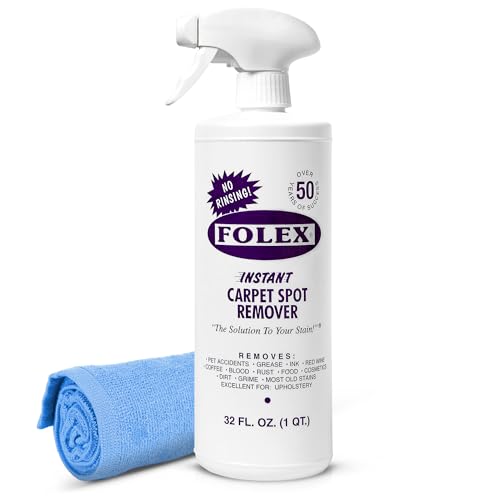
Be careful with oxygen bleach powders. They're strongly alkaline and can lighten carpet or damage wool, so check that your carpet maker allows them and test first. If you'd rather use a ready-made product, a spot remover that doesn't need rinsing is easy to keep on hand. We compared several set-in stain sprays if you want more options.
FOLEX Instant Carpet Spot Remover (32 oz)
When a Spot Cleaner Machine Helps
On a large spill, or a stain that keeps "coming back" after it dries, the problem is often wine that soaked into the backing or pad. Blotting can't reach it, but a small portable carpet cleaner can. Fill it with cool water, spray lightly, and use plenty of dry suction passes to pull the diluted wine back out. Don't use a model's heat or steam setting on wine. For more choices, see our compact spot cleaners.
BISSELL Little Green Mini Portable Carpet Cleaner

Red Wine on Wool, White and Synthetic Carpet
The basic method (blot, dilute, mild soap, rinse) is safe on almost every carpet. What changes is how far you can go after that.
Wool Carpet and Rugs
Wool soaks up red wine readily, and it's sensitive to heat, strong alkalis and bleach.
- Use only cool water and gentle, pH-neutral or wool-safe cleaners. Look for products approved by WoolSafe.
- Skip ammonia, oxygen bleach and heavy baking soda.
- Consumer Reports suggests blotting wine on a wool rug with soap and water, then a small amount of hydrogen peroxide, a capful at a time. If you try that, test it first on a hidden spot, since peroxide can lighten dyed wool.
- If wine soaked through a rug, clean the pad the same way and let both dry fully before you put the rug back.
We compared wool-safe stain removers separately, and for a deeper clean these machines for wool use gentle settings.
White and Light Carpet
Light carpet shows every trace of pink, but it also gives you the most options.
- Start with the standard method. If a shadow remains, 3% hydrogen peroxide with a drop of dish soap is usually safe on white synthetic carpet after a spot test.
- Rinse thoroughly. Any soap or residue left behind turns gray as it collects dirt.
- If you clean light carpet often, look at machines for light carpet that leave little residue.
Nylon, Polyester and Olefin (Synthetic) Carpet
Most wall-to-wall carpet in U.S. homes is synthetic.
- Nylon is soft and durable, but it can take on red dyes the way it takes on carpet dye. Many nylon carpets have a stain-resist treatment, which gives you more time. Act fast anyway.
- Polyester resists water-based stains like wine fairly well. The standard method usually works.
- Olefin (polypropylene) is often solution-dyed, meaning the color goes all the way through the fiber, so it tolerates hydrogen peroxide better than most. It holds onto oily residue, though, so rinse well. Many Berber carpets are made of olefin.
Not sure what you have? Check the label on a carpet remnant, your purchase paperwork, or the maker's website.
Stairs, Rugs and Upholstery
On stairs, keep the water to a minimum so it doesn't soak into the pad over the edge of the step. Our tips for carpeted stairs cover drying. For area rugs, put a towel underneath while you work so wine doesn't reach the floor. Upholstery follows the same blot-and-dilute method, and these upholstery cleaner picks handle both jobs. Check the cleaning code tag first. A code of "S" means solvent only, so don't use water.
Common Mistakes That Set Red Wine Stains
Heat helps the tannins and pigments in wine bond to the fiber.
Use cold or cool water at every step, and skip steam cleaners and hair dryers.
Rubbing spreads the wine and frays the pile, leaving a fuzzy patch.
Blot straight down and lift, working from the edges toward the center.
It only dilutes it, and it adds sugar and its own color.
Consumer Reports warns it can leave a brown stain. Use cold water instead.
Salt only absorbs liquid while the wine is still wet.
For dried stains, rehydrate with cold water and use soap or a spot remover.
Chlorine bleach strips carpet dye and can weaken fibers for good.
Carpet maker Shaw says bleach can’t be used as a carpet cleaner. Use 3% hydrogen peroxide only on light synthetic carpet after a test.
Extra soap stays in the pile and makes the spot attract dirt.
CRI’s advice: more is not better. Use a little, then rinse with clean water.
When to Call a Professional
DIY methods handle most red wine spills, but call a professional carpet cleaner when:
- The stain is large or covers a high-traffic area, and two or three rounds of cleaning haven't faded it.
- Wine soaked into the pad. If the spot keeps reappearing as it dries, the wine is wicking up from below. Pros have extraction tools that flush the pad, and a full-size carpet cleaner can do a lighter version at home.
- The carpet is wool, silk, a natural fiber like sisal or jute, or an antique or handmade rug. These can shrink, bleed dye or brown with home methods.
- You've already tried bleach-type products and see a lighter or yellow patch. A pro may be able to correct the color.
- Your carpet warranty is on the line. Some warranties require approved cleaning methods. Check yours before using anything strong.
CRI suggests hiring a cleaner whose company uses CRI Seal of Approval products and equipment, and checking that technicians are certified, for example by the IICRC. Tell them it's red wine, how old it is, and what you've already put on it.
How to Prevent Red Wine Stains on Carpet
- Keep a spill kit where you drink wine: white towels, a spray bottle of water, clear dish soap and a red wine remover.
- Use stemless glasses or wine glasses with wide bases at parties, and set drinks on tables, not the floor.
- Put a washable rug under the dining table or in front of the sofa.
- Ask about a stain protector after your next professional cleaning, if your carpet maker allows it.
- Have pets or kids? A pet stain cleaner handles their messes and wine spills alike.
For routine deep cleaning, a home carpet cleaner keeps the whole floor easier to spot clean.
Red Wine on Carpet FAQs
What is the fastest way to get red wine out of carpet?
Blot immediately with a white cloth, pour a little cold water or club soda on the spot, and blot again from the edges in. Repeat until no more color transfers, then treat any shadow with a mild dish soap solution and rinse.
Does baking soda remove red wine from carpet?
It helps on fresh spills by absorbing the wine as a paste, which you vacuum up once dry. It won’t break down a dried stain, and because it’s alkaline it can turn some red wine stains gray-blue. Rinse with a dish soap and vinegar mix if that happens.
Does salt get red wine out of carpet?
Salt soaks up wet wine and stops it from spreading, but it doesn’t remove the pigment. Vacuum it up after 5 to 10 minutes and finish with cold water and dish soap. It doesn’t work on dried stains.
Does club soda work better than water?
Not by much. Both work by diluting the wine. University of Georgia Extension suggests club soda for wine on carpet, but plain cold water is a fine substitute, and acting fast matters more than which one you use.
Will hydrogen peroxide bleach my carpet?
It can. Hydrogen peroxide is a mild bleach, so it may lighten dyed carpet, especially wool and dark colors. Use only 3% peroxide, only on white or light synthetic carpet, and spot test first.
Can you get out a red wine stain that's been there for days?
Often, yes. Rehydrate it with cold water, then use a dish soap and vinegar solution or a spot remover made for set-in stains, and repeat several times. Very old stains on wool or natural fibers are best left to a professional.
Can I use vinegar alone on a red wine stain?
A diluted mix works better than straight vinegar. Combine 1 tablespoon of white vinegar with 1/4 teaspoon of clear dish soap in 1 cup of cool water, then rinse with plain water so no smell or residue remains.
Should I use a steam cleaner on red wine?
No. Heat can set the tannins and pigments in wine. If you use a carpet cleaning machine, fill it with cool water and turn off any heat or steam setting.
Why does the wine stain come back after it dries?
That’s called wicking. Wine that soaked into the backing or pad rises back up as the carpet dries. Blot with less water, dry the spot under a weighted stack of paper towels, or use a portable extractor to pull the wine out from below.
The Bottom Line on Red Wine Stains
- Blot fast with a white cloth, from the edges in
- Dilute with cold water or club soda, never hot water
- Use 1/4 teaspoon of clear dish soap per cup of cool water
- Use salt or baking soda only on wet spills, then vacuum
- Save hydrogen peroxide for light synthetic carpet after a test
Speed and cold water do most of the work. Blot, dilute, treat gently and rinse, and most red wine spills disappear without a trace. Go slowly with dried stains, protect wool and dark carpet from bleach-type remedies, and call a professional when the wine has reached the pad or the carpet is delicate.
How We Picked and Tested
This guide is built on published guidance from carpet industry, university and consumer testing sources, not on cleaning myths or marketing claims. The core method (blot, work from the edges in, use a little mild cleaner, rinse with clear water) follows the Carpet and Rug Institute’s spot and stain guidance. CRI is the carpet industry’s national trade association and runs the Seal of Approval program that tests carpet cleaning products and equipment. The cool-water start and the club soda step for wine come from University of Georgia Extension’s guide to removing wine and beer stains. The advice on wool rugs, avoiding heat and never using white wine on red comes from Consumer Reports. We also drew on carpet maker Shaw’s residential carpet care guidelines (no bleach, pH-neutral cleaners, drying under weight), the WoolSafe program for wool-safe products, and the IICRC for professional cleaner certification. The note on red wine turning gray-blue under alkaline products reflects the well-documented pH sensitivity of anthocyanins, the pigments that color red wine.
We compared this advice with the pages that currently rank and get cited for this question, then kept only the steps our sources support and added the cautions they leave out, such as when baking soda backfires, why salt does nothing on dried stains, and which carpets can handle hydrogen peroxide.
We chose the four recommended products with two rules, and all four meet both. First, each one does a specific job in the method above: white cotton towels for blotting, Wine Away for a fresh wine shadow, FOLEX for a dried spot, and the BISSELL Little Green Mini for rinsing wine out of the pile and pad. Second, none of them needs heat or steam, so each fits the cool-water method this guide recommends. We checked each product against its maker’s information and the current Amazon listing in October 2026. The scores are our editorial judgment of how well each product fits its job, not lab results. We have not run our own lab tests. Always follow your carpet maker’s care instructions first, since some warranties require specific products or professional cleaning.
Why trust CleanTheFloor?
CleanTheFloor publishes practical floor-care advice and buying guides for homeowners and pet owners. We base our advice on guidance from industry bodies, carpet makers, university extension services and published independent tests rather than marketing claims, and we point out the risks of each method.