Door thresholds, raised floor transitions and thick rug edges are where most robot vacuums give up. A standard robot climbs only about 20 mm, so it bumps into the edge, spins its wheels and leaves whole rooms uncleaned. The best robot vacuum for high thresholds should lift itself over tall and two-step thresholds, keep its balance on uneven floors, and still clean well once it gets to the other side. It should also keep its mop off your rugs and fit under the furniture in the rooms it reaches.
We compared 5 climbing robot vacuums across different price ranges and home layouts to help you find the right one for your floors.
Our top 3 robot vacuums for high thresholds


See how all 5 robot vacuums compare in our side-by-side comparison chart ↓
The best robot vacuum for high thresholds, by need
- Best overall: Roborock Saros 20 Cleared a 57 mm threshold in independent testing, the highest result we found, and its lifting chassis keeps it level over uneven floors.
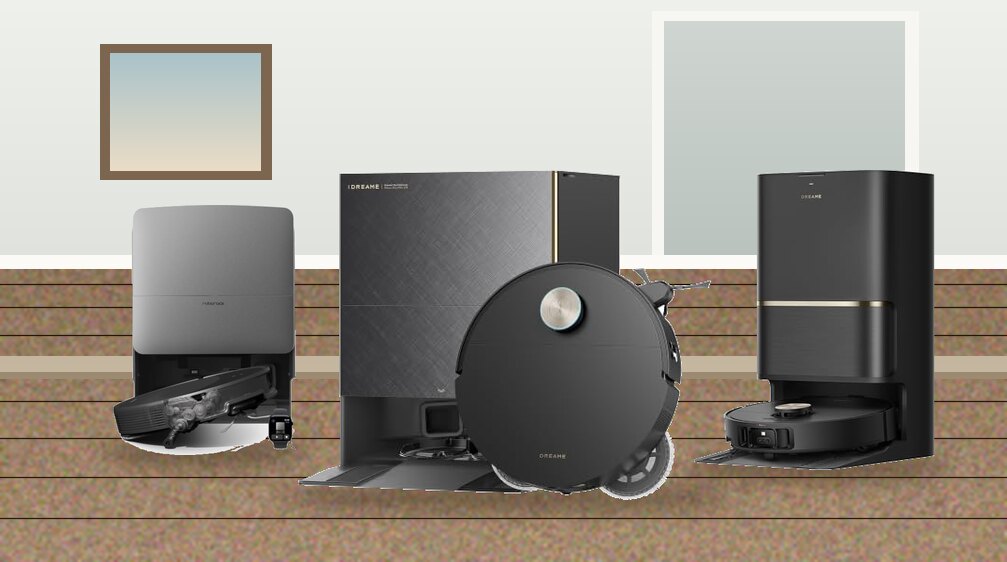
- Best for low furniture: Dreame X60 Max Ultra Complete Climbing legs cleared 51 mm in testing, yet the robot is only 3.13 inches tall, so it also cleans under low sofas and beds.
- Best mid-range: Dreame L60 Pro Ultra The same ProLeap legs and 51 mm test result as the X60 Max, with a 90% carpet deep-clean score, for less money.
- Best value: MOVA Z60 Ultra Roller Complete Also cleared 51 mm in testing and posted the best mopping score of our picks, at the lowest price when we checked.
- Best for pet hair: Dreame L50 Ultra Picked up 100% of pet hair in a carpet test and crossed a real two-step sunroom threshold in both directions.
Every pick has climbing legs or a lifting chassis rated for single steps of at least 42 mm, cleared at least 38 mm in independent testing, beat the average in a carpet deep-clean test and keeps its mop off rugs.
The 5 Best Robot Vacuums for High Thresholds
Roborock Saros 20

- Cleared a 57 mm threshold in independent testing, a record for that lab
- Rated for 1.77 in single sills and 3.46 in two-step thresholds
- Chassis lifts the whole body, which helps on bumpy transitions
- Removed 89% of embedded sand from carpet with zero hair wrap
- One of the two priciest picks here
- Avoided 17 of 24 obstacles, the lowest of our picks
- A hands-on reviewer saw it get trapped and drag a doormat
- Strings and toy cords wrapped its rollers in that review
Roborock Saros 20 review
The Saros 20 is our top pick because it climbs higher than anything else we found. Roborock rates it for single door sills up to 1.77 inches (45 mm) and two-step thresholds up to 3.46 inches. In independent threshold testing, it went further than that rating and cleared 57 mm, the best score that lab has recorded.
Most climbers push themselves up on two legs. The Saros 20 raises its whole chassis instead, which helps on uneven floors such as raised tile edges, warped boards and bumpy rug transitions. It drops back down to keep its brush on the floor once it's across.
Cleaning holds up too. It removed 89% of embedded sand from carpet against a 77% average, and long hair never wrapped its brush.
The weak spot is navigation in clutter. It avoided 17 of 24 obstacles in testing, and a separate hands-on reviewer saw it get trapped between furniture and drag a doormat. Pick up cords and loose mats first. If your floors are messy, the Dreame X60 Max avoids more obstacles.
Dreame X60 Max Ultra Complete

- Cleared a 51 mm threshold in independent testing
- Only 3.13 inches tall for low sofas and beds
- Avoided 22 of 24 obstacles, tied for the best of our picks
- Mop lifts 21.5 mm on carpet or stays in the dock
- Most expensive pick here
- Battery covers less area per charge than average
- Small onboard dustbin
- Mopping scored below average in testing
Dreame X60 Max Ultra Complete review
The X60 Max is the pick for homes where the problem is both high doorways and low furniture. Most robots that climb well are tall. This one has retractable ProLeap legs rated for 45 mm single steps and 3.47-inch two-step thresholds, but its body is only 3.13 inches high.
The climbing is proven. In independent testing, it cleared a 51 mm threshold, close to the top of that lab's leaderboard. It also avoided 22 of 24 obstacles, which matters on this list, because a robot that crosses a doorway and then tangles on a cable still fails the job.
It cleans carpet well, removing 89% of embedded sand and 100% of flattened pet hair in testing, and it lifts its mop 21.5 mm when it reaches a rug. You can also leave the pads in the dock.
The catches are a small onboard bin, weak battery coverage and below-average mopping. If your thresholds are taller than 50 mm, the Saros 20 climbed higher in the same tests.
Dreame L60 Pro Ultra

- Cleared a 51 mm threshold in independent testing
- Rated for 45 mm single steps and 3.47 in two-step thresholds
- Removed 90% of embedded sand from carpet, tied for best here
- Avoided 22 of 24 obstacles with zero hair wrap
- Mop lifts only 10.5 mm on carpet
- Uses more water than average when mopping
- Below-average battery coverage
- Taller than the X60 Max at about 3.5 inches
Dreame L60 Pro Ultra review
The L60 Pro Ultra is the robot to buy if you want top-tier climbing without paying top-tier prices. It shares the ProLeap leg system with the X60 Max, with the same ratings of 45 mm for single steps and 3.47 inches for two-step thresholds.
In independent testing it cleared a 51 mm threshold, matching the X60 Max. It also removed 90% of embedded sand from carpet, picked up 93.5% of pet hair and avoided 22 of 24 obstacles, so once it's over a doorway, it keeps cleaning instead of getting stuck.
You give up two things for the lower price. The robot is about 3.5 inches tall, so check the gap under your sofa. And its mop lifts only 10.5 mm, which is fine on thin rugs but not deep pile. It solves that by dropping the pads in the dock for vacuum-only runs.
Battery coverage is below average, so a large home will see it go back to recharge. If low furniture matters, step up to the X60 Max.
MOVA Z60 Ultra Roller Complete

- Cleared a 51 mm threshold in independent testing
- Best mopping score of our five picks
- Zero hair wrap in a long-hair test
- Lowest price of our picks when we checked
- Covers only about 582 sq ft per charge in testing
- Slower than average navigation
- Auto-empty clogged once on a small piece of plastic
- Lowest carpet deep-clean score here, though still above average
MOVA Z60 Ultra Roller Complete review
The Z60 Ultra Roller Complete is the best value because it climbs like a flagship for noticeably less. MOVA rates its StepMaster legs for about 45 mm single steps and two-step thresholds up to 80 mm (3.14 inches). In independent threshold testing it cleared 51 mm, tied with both Dreame flagships.
It's also the best mopper here. Instead of spinning pads, it uses a roller mop that's rinsed with clean water as it runs, and it scored well above average in dried-stain tests. When it detects carpet, it lifts the roller and lowers a shield to keep rugs dry. Long hair didn't wrap its brush at all.
The tradeoffs are speed and range. It moved slower than average and covered only about 582 square feet per charge in testing, so bigger homes need recharge-and-resume. Its carpet score of 85% beats the 77% average but trails the other picks.
If you want stronger carpet cleaning at a similar price, look at the Dreame L50 Ultra.
Dreame L50 Ultra

- Picked up 100% of pet hair from carpet in testing
- Crossed a two-step sunroom threshold both ways in testing
- Removed 90% of embedded sand from carpet
- Tangle-resistant DuoBrush and pads that stay in the dock
- Lowest tested climb of our picks at 38 mm
- Two-step rating is only 2.65 inches
- Weakest battery coverage here
- Mopping struggled on the lowest water setting
Dreame L50 Ultra review
The L50 Ultra is the pick for pet owners who also fight thresholds. Dreame rates its ProLeap legs for 42 mm single steps and two-step thresholds up to 2.65 inches, the lowest ratings on our list but still about twice what a standard robot can handle.
Its real-world climbing is the most convincing of any review we read. In independent testing, it crossed a two-step sunroom threshold of about 38 mm in both directions, going in and coming back out. A rival roller-mop robot made it across that same threshold once and failed on the way back.
For pets, it's excellent. It picked up 100% of flattened pet hair from carpet, removed 90% of embedded sand and avoided 20 of 24 obstacles. Its magnetic mop pads stay in the dock when you choose vacuum-only carpet modes.
Battery is the catch. It covered the least area per charge of our picks in testing, so large homes will see it stop to recharge. If your doorways are over 40 mm, choose one of the 51 mm climbers instead.
Robot vacuums for high thresholds compared
|
Best overall
Roborock Saros 20
|
Best for low furniture
Dreame X60 Max
|
Best mid-range
Dreame L60 Pro
|
Best value
MOVA Z60 Roller
|
Best for pet hair
Dreame L50 Ultra
|
|
|---|---|---|---|---|---|
|
|
|
|
|
|
|
| Climbing system | Lifting chassis | Climbing legs | Climbing legs | Climbing legs | Climbing legs |
| Single step (maker) | 45 mm | 45 mm | 45 mm | 45 mm | 42 mm |
| Two-step threshold (maker) | 3.46 in | 3.47 in | 3.47 in | 3.14 in | 2.65 in |
| Threshold cleared in testing | 57 mm | 51 mm | 51 mm | 51 mm | 38 mm |
| Carpet deep clean (test) | 89% | 89% | 90% | 85% | 90% |
| Obstacles avoided (test) | 17 of 24 | 22 of 24 | 22 of 24 | 21 of 24 | 20 of 24 |
| Mop type | Spinning pads | Spinning pads | Spinning pads | Roller mop | Spinning pads |
| Mop on carpet | Mops detach | Lifts 21.5 mm or stays docked | Pads stay docked | Roller lifts + shield | Pads stay docked |
| High threshold fit | 5 | 5 | 5 | 4 | 4 |
| Current price | $1,599.99 | $1,699.99 | $1,189.99 | $799.00 | $899.99 |
| Read review | Read review | Read review | Read review | Read review |
Robot vacuums for high thresholds compared


Prices and availability change often. Climbing ratings and suction come from maker listings. Test results come from the independent sources named in How We Picked and Tested. Star ratings are our editorial judgment, not our own lab tests.
How high is a high threshold?
A threshold is the strip or step where one floor meets another, usually in a doorway. Most robot vacuums are built for low ones. A typical robot rides on fixed wheels and climbs about 20 mm (0.8 inch), and many reviewers find that anything over about 2 cm takes several tries or stops the robot completely.
That covers a lot of newer homes. US accessibility guidelines (the ADA standards) cap accessible door thresholds at half an inch, and modern floor transitions are often flush. Older homes are different. Marble door saddles, raised hardwood strips, patio door tracks, and transitions where new flooring was laid over old often stand an inch or more.
Here's a simple way to read the numbers:
- Under 20 mm (0.8 in): almost any robot works.
- 20 to 40 mm (0.8 to 1.6 in): you need a robot rated above 20 mm, and a climbing robot is safer.
- Over 40 mm (1.6 in): you need climbing legs or a lifting chassis, like every pick on this page.
Two-step (double) thresholds are a separate rating. Makers test them with a gap between the two steps, so check the fine print. Roborock, for example, rates the Saros 20 for two steps of up to about 1.77 and 1.69 inches with a gap of 4.72 to 5.51 inches between them. If your thresholds are low and your budget is tight, a regular robot from our list of budget robot vacuums with mapping is a better buy.
Robot vacuums on uneven floors
Uneven floors cause the same trouble as thresholds, just spread across the room. Think raised tile edges, boards that have cupped or warped, rug edges, floor vents, and spots where two floors meet at slightly different heights. A standard robot can tilt, lose traction or beach itself on these bumps.
Climbing robots handle them better for two reasons. Legs or a lifting chassis add ground clearance when the robot needs it, then lower again so the brush stays in contact. And their wheels and sensors are tuned to try a bump again from a better angle instead of giving up.
Rug edges are the most common uneven spot in a home. A thin, flat rug is easy, but a thick rug with a raised edge is basically a threshold. If deep rugs are your main problem, our guide to the best robot vacuum for thick carpet ranks climbers by how well they clean the pile once they're on it.
What no robot can do is go down a true step. Cliff sensors stop it at the edge of stairs or a sunken living room, which is what keeps it from falling. Those rooms still need a separate run.
Fringe and loose mats are a different problem. They catch in brushes rather than blocking the robot, so set no-go zones around them or tuck them under. For rugs that need gentler care, see our picks for the best vacuum for area rugs.
How to choose a robot vacuum for high thresholds
This is the number that matters for an ordinary doorway. Measure your tallest threshold with a ruler before you shop.
Maker ratings are measured in ideal conditions. Independent tests show what the robot clears on real strips and steps.
Some doorways have a strip plus a raised floor behind it. These need a separate two-step rating.
Doorways collect cords, shoes and pet toys. A robot that climbs well but snags on clutter still stops short.
Climbing hardware can make robots taller, which costs you the space under sofas and beds.
Crossing into a carpeted room with a wet mop can leave a damp stripe at the doorway.
Do you need LiDAR for a home with lots of thresholds?
Climbing gets a robot over the doorway, but navigation decides whether it goes through the right doorway at all. Every pick here uses laser navigation to build a room-by-room map, then lets you name rooms, set the cleaning order and draw no-go zones. That matters more than usual in a home full of thresholds, because you can mark a patio door track or a sunken step as off-limits and send the robot to the rooms it can actually reach.
Some of our picks hide or lower the laser tower to stay slim, while others keep it on top. If you want to compare how each type maps a home, our guide to the best robot vacuum with LiDAR covers turret, retractable and built-in sensors.
How to set up a robot vacuum for high thresholds
-
Measure every threshold
Measure the tallest point of each doorway strip and any two-step transition, including the gap between steps. Compare them with the robot’s single-step and two-step ratings.
-
Run a mapping pass first
Let the robot map the whole home with doors open. Check that it reached every room, then fix any rooms it merged or missed in the app.
-
Turn on the climbing setting
Some robots only use their full climbing ability when a threshold or obstacle-crossing mode is on. Check the app settings after the first run.
-
Block what it shouldn't cross
Set no-go lines at patio door tracks, sunken steps and pet bowls. A climbing robot will try thresholds you don’t want it to cross.
-
Add a ramp if you're just short
If one threshold is a few millimeters too tall, a small rubber threshold ramp gives the robot a gentle slope to climb.
-
Keep wheels and sensors clean
Hair on the wheels cuts traction on climbs, and dusty cliff sensors can make a robot refuse a doorway. Clean both every week or two.
High threshold robot vacuum FAQs
What is the best robot vacuum for high thresholds?
The Roborock Saros 20. It cleared a 57 mm threshold in independent testing, the best result we found, and is rated for two-step thresholds up to 3.46 inches. If you also have low furniture, the Dreame X60 Max Ultra Complete cleared 51 mm and is only 3.13 inches tall.
How high a threshold can a robot vacuum climb?
Most standard robots climb about 20 mm (0.8 inch). Robots with climbing legs or a lifting chassis are rated for 42 to 45 mm single steps, and the best cleared 51 to 57 mm in independent testing.
What is the difference between a single and a two-step threshold rating?
A single-step rating is the tallest one step the robot can climb. A two-step rating is the total height of two steps in a row with a gap between them, so it is always bigger. Check that each of your steps is under the single-step figure.
Can a robot vacuum work on uneven floors?
Yes, if the bumps are small. Climbing robots handle raised tile edges, warped boards and rug edges better than standard robots because they can raise themselves. No robot can go down a real step, since cliff sensors stop it at the edge.
Will a threshold ramp help my robot vacuum?
Often, yes. A rubber ramp turns a sharp edge into a slope, which can get a standard robot over a threshold that is a few millimeters too tall. It won’t help with very tall steps.
Do climbing robot vacuums mop too?
All five picks here vacuum and mop, and they keep the mop off rugs by lifting it, leaving it in the dock or covering it. If mopping is your main goal, compare more models in our guide to the best robot vacuum and mop combo.
Are climbing robots good on tile with grout lines?
Yes. Grout lines and slight tile lippage are small bumps that climbers cross easily. For tile homes with low thresholds, see our picks for the best robot vacuum for tile floors.
Do these robots handle pet hair at doorways?
Yes. The Dreame L50 Ultra and X60 Max both picked up 100% of pet hair in a carpet test. For heavy shedding on carpet, pair a robot with one of the best vacuums for pet hair on carpet.
Which robot vacuum should you buy for high thresholds?
- Best overall: Roborock Saros 20
- Best for low furniture: Dreame X60 Max Ultra Complete
- Best mid-range: Dreame L60 Pro Ultra
- Best value: MOVA Z60 Ultra Roller Complete
- Best for pet hair: Dreame L50 Ultra
Measure your tallest threshold first, then pick a robot rated comfortably above it. The Roborock Saros 20 climbs the highest. The Dreame X60 Max is the best choice if low furniture matters too, the L60 Pro Ultra gives you the same climbing for less, the MOVA Z60 is the best value and best mopper, and the L50 Ultra is the pick for pet hair. Still unsure a robot fits your home? Read our take on whether robot vacuums are worth it.
How We Picked and Tested
We started with what this search is really asking: which robot can get over a tall doorway or a bumpy floor transition and keep cleaning on the other side. Before looking at any model, we set four pass/fail rules, and all five picks meet all four. First, climbing hardware: each has retractable climbing legs (Dreame ProLeap, MOVA StepMaster) or a lifting chassis (Roborock AdaptiLift), rated by its maker for single steps of at least 42 mm (about 1.65 inches). Second, outside proof: each cleared at least a 38 mm threshold in independent testing. Third, real cleaning: each beat the average in an independent embedded-sand carpet deep-clean test. Fourth, dry rugs: each keeps its mop off carpet when it crosses into a carpeted room, by leaving pads in the dock, detaching or lifting them, or covering its roller mop with a shield.
Those rules ruled out many popular robots. Standard fixed-wheel models, including the Roborock Qrevo Curv 2 Flow, are limited to roughly 20 mm thresholds in testing. The Dreame Aqua10 Ultra Roller climbed 42 mm but failed a two-step threshold on the way back and was pulled from a major top list after base-station leak complaints. Awards reflect each robot’s real strength: the Saros 20 has the highest tested climb, the X60 Max is the only 51 mm climber under 3.2 inches tall, the L60 Pro Ultra matches the flagship result for less, the MOVA Z60 was the lowest-priced qualifying robot on Amazon when we checked in October 2026 and had the best mopping score, and the L50 Ultra had a perfect pet hair score.
For performance, we relied on independent testing rather than marketing. Our main source was Vacuum Wars, which runs a repeatable threshold test that starts at 19 mm and adds quarter-inch strips until a robot fails, plus the same embedded-sand carpet test, pet hair test, hair-wrap test and 24-object obstacle course on every robot. All tested threshold heights, carpet percentages and obstacle scores on this page come from its reviews of these five models. For real-home behavior, we used Tech Advisor‘s hands-on Saros 20 review, the source of its trapping and string-wrap issues, and Galaxus’ long-running home threshold tests, which show how standard robots struggle once a step passes about 2.5 cm.
We checked every climbing rating, two-step rating and robot height we mention against the makers’ own listings, including Roborock’s Saros 20 spec page, Dreame and MOVA product pages and the current Amazon listings in October 2026. For typical threshold heights, we used the US ADA accessibility standards for door thresholds. Climbing ratings are maker claims measured in ideal conditions, and test results are labeled as such. We did not test these robots ourselves, and we point out each one’s limits so you can match it to your doorways.
Why trust CleanTheFloor?
CleanTheFloor publishes practical floor-care advice and buying guides for homeowners and pet owners. We base our picks on published test results and verified specifications rather than marketing claims, and we point out each product's drawbacks.