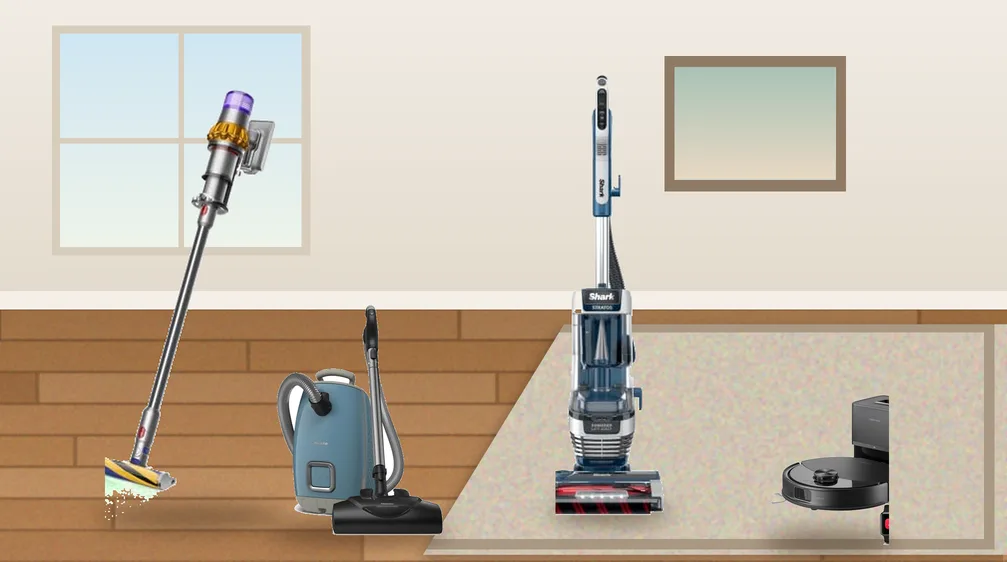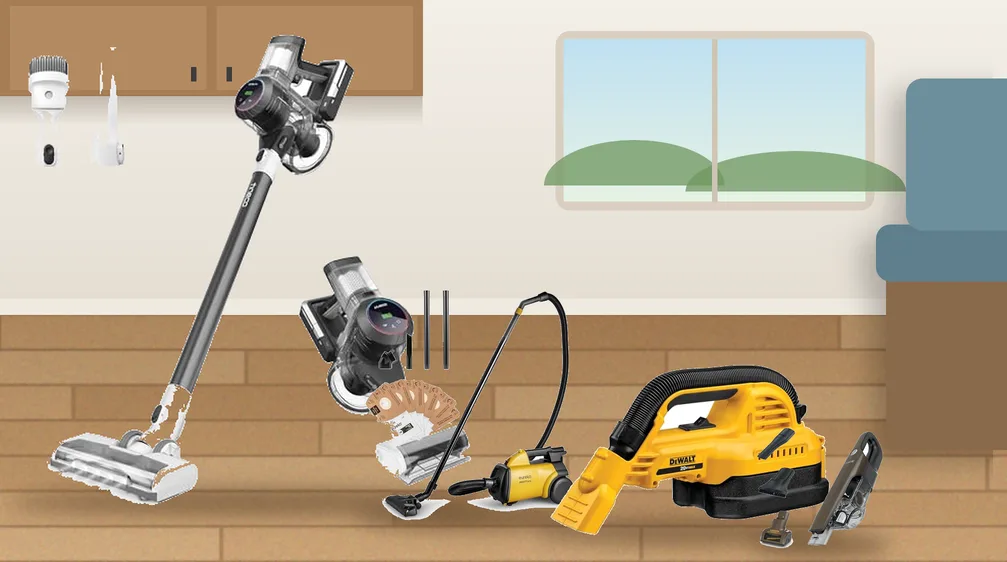
An RV gets as dirty as a house in a fraction of the space. Sand, gravel, pet hair and crumbs pile up by the door, and you have little room to store a vacuum and limited power to run one. The best vacuum for RV use is light, stores in a small cabinet and runs on the power you actually have, whether that's shore power, a generator or your battery bank. For most rigs, that's the Tineco Pure ONE S11, a quiet cordless stick that turns into a handheld. If you camp with hookups and want stronger, cheaper suction, the corded Eureka Mighty Mite is the better fit.
Our top 3 vacuums for RVs


See how all 7 RV vacuums compare in our side-by-side comparison chart ↓
The 7 Best Vacuums for RVs
Tineco Pure ONE S11

- Dust sensor adjusts suction on its own, which saves battery
- Measured at about 60 dB in a published review, quieter than many sticks
- Removable battery, so a spare doubles your off-grid cleaning
- 0.6-liter bin, larger than many stick vacuums
- Top-heavy, which tires your wrist on long sessions
- Trigger power switch instead of a button
- Not for shag carpet, per Tineco
- Up to 40 minutes, less with the power brush
Tineco Pure ONE S11 review
The Pure ONE S11 is our top pick because it fits the way most people actually use a vacuum in an RV: quick, cordless passes over vinyl floors and small rugs, then a few minutes on the seats and steps. It pulls apart into a handheld, and the battery clicks out, so you can charge a spare off solar.
Its iLoop sensor reads how much dirt is coming through and raises suction for the sandy patch by the door, then drops back on clean floor. That stretches the battery, which Tineco rates at up to 40 minutes with the small brush and about 30 minutes with the power brush in eco mode. In one hands-on review, it picked up both cat litter and kibble, often in one pass, and measured around 60 decibels, which matters in a small rig.
The 0.6-liter bin holds more than many sticks. The weak points are comfort and carpet. That reviewer found it top-heavy, the trigger has to be held down and Tineco says to avoid shag carpet.
Choose it for a trailer, fifth wheel or motorhome with mostly hard floors and some rugs. If you're on a tight budget, the Levoit costs less.
Eureka Mighty Mite 3670M
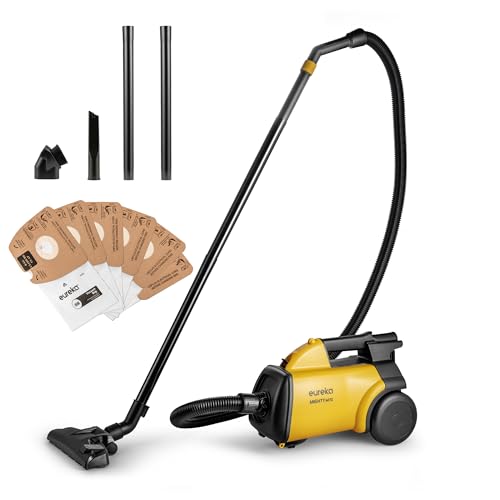
- Steady suction that never fades like a battery
- Bags hold sand and pet hair, with no dusty bin to empty
- Two extension wands and two attachments for above-floor cleaning
- 8.6 pounds, light for a corded canister
- Needs an outlet, so it’s a poor fit for dry camping
- 12-amp motor: turn off the AC first on a 30-amp hookup
- No powered brush for deep carpet cleaning
- 1-year warranty
Eureka Mighty Mite 3670M review
The Mighty Mite is the vacuum we'd keep in a rig that lives on shore power. It's a compact bagged canister, and in one survey of truck camper owners, plug-in vacuums came up slightly more often than cordless ones among owners with hookups or a strong inverter, because suction stays steady and there's no battery to babysit.
Eureka lists it at 8.6 pounds with a 1,200-watt, 12-amp motor and a 2.5-liter bag. Two extension wands and two attachments reach the bunk over the cab, the dash, ceiling corners and the gaps under seats without moving the canister. Bags keep sand and pet hair sealed in.
Watch your power. A 12-amp draw is fine on a 50-amp rig, but on a 30-amp hookup, turn off the air conditioner and the microwave before you start. It isn't built for off-grid use unless you have a large inverter. It also has no powered brush, so it's better on vinyl and rugs than on thick carpet.
Buy it if you mostly stay at full-hookup campgrounds. If you boondock, the Tineco or Levoit is a better fit.
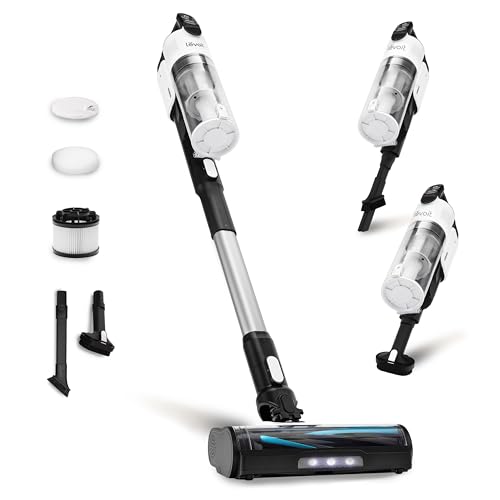
Levoit LVAC-200
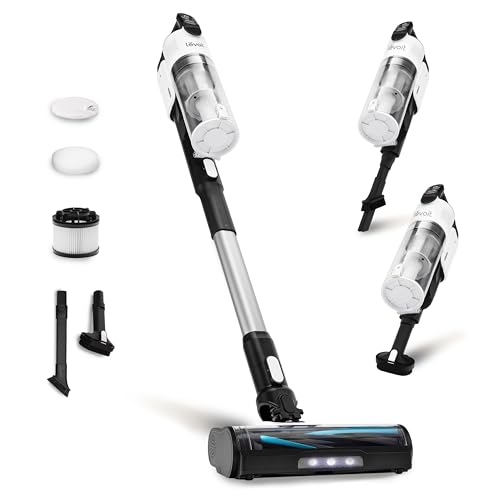
- Low price for a full stick-and-handheld kit
- Anti-tangle brush handles long pet hair
- Strong pickup of fine debris on hard floors in published tests
- Removable battery, so a spare doubles runtime
- Weaker on plush carpet
- About 30 minutes with the floor head, per Levoit
- Not a HEPA filter
- Four to five hours to charge
Levoit LVAC-200 review
The LVAC-200 gives you most of what the Tineco does for less money. The handheld body weighs about 3.2 pounds, and it's about 6.2 pounds with the wand and floor head. In published hands-on tests, it picked up flour in a single pass and handled larger debris on hard floors better than many stick vacuums.
That makes it a strong match for the vinyl plank and linoleum floors in most newer trailers and motorhomes. The brush resists tangles, which helps if you travel with a long-haired dog, and the battery comes out to charge separately.
Runtime depends on the tool. Levoit lists about 30 minutes with the floor head, up to 50 minutes in eco mode with the small tools and about 12 minutes on turbo. For a typical RV floor, 30 minutes is plenty.
The trade-offs are carpet and charging. It lacks stiff bristles, so plush bedroom carpet in an older rig won't come as clean, and a full charge takes four to five hours. Choose it for a hard-floor rig on a budget. If you want a dust sensor and a bigger bin, step up to the Tineco.
BISSELL Featherweight Stick

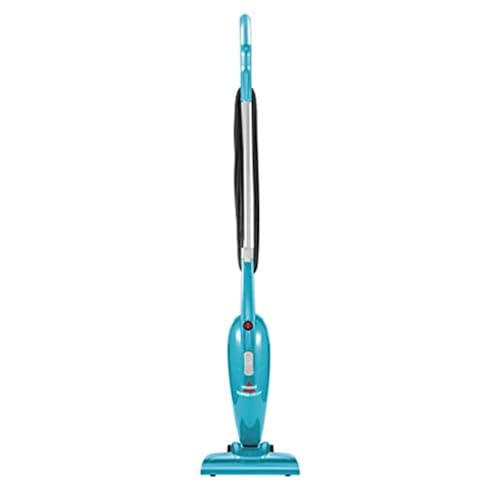
- Draws just 2 amps, per BISSELL
- 2.6 pounds and fits a small cabinet
- Stick, handheld and stair modes
- Very low price
- No brush roll, so it’s weak on carpet
- 15-foot cord means moving outlets
- Small 0.67-liter bin
- 1-year warranty
BISSELL Featherweight Stick review
The Featherweight is a simple corded stick, and its low power draw is why it's here. BISSELL lists it at 2 amps, a fraction of what a full-size vacuum pulls. That means it can run off a modest inverter or a small generator, and you can use it on a 30-amp hookup without turning off the air conditioner.
It weighs 2.6 pounds. Lift the stick off the floor nozzle and you have a handheld for cushions and counters, or use the nozzle by hand on carpeted RV steps. The clear 0.67-liter dirt cup shows when it's full and empties easily.
Know what you're getting. It's suction only, with no spinning brush, so it does fine on vinyl, tile and low rugs but leaves pet hair and grit behind in carpet. The 15-foot cord means you'll switch outlets in a longer rig, and it carries a 1-year warranty.
Get it if your power is limited, your floors are hard and you want something cheap you won't worry about. If you have carpet or pets that shed a lot, the Levoit or Tineco will do a better job.
Shark UltraCyclone Pet Pro+

- Small enough for a drawer or door pocket
- Self-cleaning pet power brush for upholstery
- Crevice tool for seat tracks and bunk edges
- Dirt ejector for no-touch emptying
- Short runtime, best for quick cleanups
- Small dust cup
- Not comfortable for a full floor
- Takes hours to recharge
Shark UltraCyclone Pet Pro+ review
Small rigs need a small vacuum. The UltraCyclone Pet Pro+ is a cordless handheld that stores in a drawer, a cubby or a door pocket. It handles the messes that come up most in a van or truck camper: crumbs in the bed, dog hair on the seats and grit on the step.
The self-cleaning pet power brush spins to lift hair from upholstery and small rugs and is built to stop hair from wrapping around it. A crevice tool reaches between the mattress and the wall and along seat tracks, and a scrubbing brush loosens dried mud from mats. When the cup is full, the dirt ejector pushes debris out so you don't have to dig it out by hand.
The limits are runtime and capacity. Like most handhelds, it runs for minutes, not half an hour, and the dust cup is small, so it's a spot cleaner. You'll be on your knees to vacuum a whole floor with it.
Buy it as the only vacuum in a van, a truck camper or a teardrop, or as a second vacuum in a larger RV. For a travel trailer or motorhome floor, start with the Tineco.
DEWALT 20V MAX DCV517B

- Wet and dry pickup
- Large half-gallon tank for a hand vac
- Washable HEPA filter for wet or dry use
- Uses DEWALT 20V MAX tool batteries
- Bare tool, battery and charger sold separately
- No floor head, so not a main floor vacuum
- Loud and boxy
- Runtime depends on the battery you use
DEWALT 20V MAX DCV517B review
The DCV517B is a different kind of vacuum, and every RV can use one. It handles wet messes, which stick and canister vacuums can't. Think of a puddle from a shower that didn't drain, a leaking water line under the sink, a wet outdoor mat or mud tracked into a basement storage bay.
The half-gallon tank is big for a hand vacuum. A washable HEPA filter works for both wet and dry pickup, so you don't swap parts between jobs. Use the wide front nozzle for larger spills or pull out the hose, which stretches from about 2.5 to 5 feet, to reach under the dinette or deep into a bay.
It runs on DEWALT 20V MAX batteries. If you already carry DEWALT drills or impact drivers for leveling and repairs, this adds little weight or cost. If you don't, the battery and charger add a lot. DEWALT doesn't list a runtime because it depends on the pack, and it covers the tool with a 3-year limited warranty.
It's loud and has no floor head, so pair it with a main vacuum. Buy it if water, mud or tool batteries are part of your RV life.
Dirt Devil CV1500 Central Vacuum

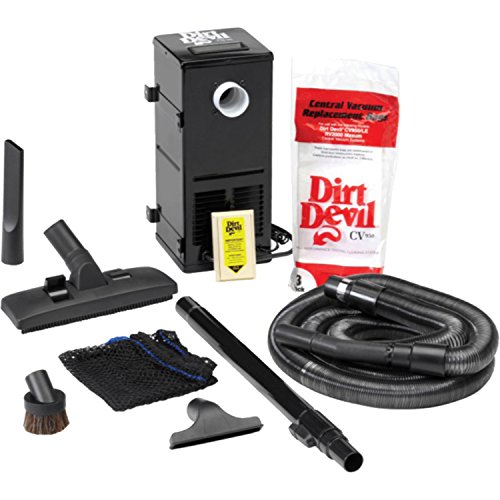
- Motor hides in a cabinet, under a seat or in a bay
- Hose stretches from 7 to 35 feet
- HEPA filter bags and 1-gallon capacity
- Floor, upholstery, dusting and crevice tools included
- Needs installation and a 120-volt outlet
- Draws up to 11.7 amps
- Sold by a third-party seller on Amazon
- Costs more than a portable vacuum
Dirt Devil CV1500 Central Vacuum review
Many motorhomes and fifth wheels have a central vacuum built in, and when an old one dies, the Dirt Devil CV1500 is a common replacement. A central vac needs just one outlet.
The power unit weighs about 14 pounds and is small enough to mount inside a cabinet, under a dinette seat or near a sink base. You plug the hose into a wall inlet, and the hose stretches from 7 to 35 feet, which covers front to back in most rigs. Specs list 100 CFM of airflow, 501 air watts and up to 11.7 amps. Dirt goes into a 1-gallon HEPA filter bag, which lasts much longer than a stick vacuum's bin. The kit includes floor, upholstery, dusting and crevice tools.
It isn't a grab-and-go tool. You need to install it, it draws close to what a household vacuum does and the long hose takes up space when stored. On Amazon it ships from a third-party seller.
Choose it if your rig has a central vac port or a worn-out unit to replace. For everyone else, a cordless stick like the Tineco is simpler.
RV vacuums compared
|
Best overall
Tineco Pure ONE S11
|
Best corded
Eureka Mighty Mite
|
Best budget cordless
Levoit LVAC-200
|
Best for low power
BISSELL Featherweight
|
Best handheld
Shark UltraCyclone
|
Best for wet messes
DEWALT DCV517B
|
Best built-in
Dirt Devil CV1500
|
|
|---|---|---|---|---|---|---|---|
|
|
|
|
|
|
|
|
|
| Type | Cordless stick | Corded canister | Cordless stick | Corded stick | Cordless handheld | Wet-dry hand vac | Central vac |
| Power | Battery | 12 amps | Battery | 2 amps | Battery | 20V tool battery | 11.7 amps |
| Works off-grid | 1 | – | 1 | – | 1 | 1 | – |
| Wet pickup | – | – | – | – | – | 1 | – |
| Best floors | Hard, carpet | Hard, rugs | Hard floors | Hard floors | Seats, rugs | Spills, bays | Hard, rugs |
| Easy to store | 4 | 3 | 4 | 5 | 5 | 4 | 3 |
| Cleaning power | 4 | 4 | 4 | 3 | 3 | 3 | 4 |
| Current price | $179.00 | $69.99 | $139.94 | $29.98 | $99.99 | $99.00 | $312.94 |
| Read review | Read review | Read review | Read review | Read review | Read review | Read review |
RV vacuums compared


Prices and availability change often. Weights, amp draws and runtimes are maker figures, and test results come from the published sources named in How We Picked and Tested. Star ratings are our editorial judgment, not our own lab tests.
What type of vacuum is best for an RV?
The right type depends on two things: where your power comes from and how much floor you have.
Cordless sticks suit most travel trailers, fifth wheels and motorhomes. They work anywhere, charge from a regular outlet or inverter and turn into handhelds for seats and steps. If cordless is where you're leaning, our guide to the best cordless vacuums for RVs compares more models.
Corded vacuums suit people who camp with hookups. They cost less for the same suction and never run out of battery, but they need an outlet and some power to spare.
Handhelds are enough for camper vans, truck campers and teardrops, where there's little floor and less storage.
Wet-dry vacuums are a second tool for spills, wet mats and storage bays.
Central vacuums make sense in larger motorhomes and fifth wheels that already have a port.
How to choose a vacuum for your RV
Boondockers need a battery vacuum or one that runs on a small inverter. Campers on shore power can use corded models, but should check the amp draw.
Space decides more RV purchases than suction does. Measure the closet, cabinet or bay where the vacuum will live before you buy.
You’ll carry the vacuum up the entry steps, into the bunk area and out to the truck.
Most newer RVs have vinyl plank or linoleum, while older rigs may have carpet in the bedroom or on the steps.
Slide-out tracks, seat rails, window channels and vents collect dirt that a floor head can’t reach.
Sand and pet hair fill small bins quickly, and you’ll empty it outside.
How many amps can a vacuum use in an RV?
A 30-amp hookup gives you about 3,600 watts in total, and a rooftop air conditioner can use a big share of that on its own. Most corded vacuums, including our Eureka pick at 12 amps and the CV1500 central vac at up to 11.7 amps, pull enough that running one with the AC on can trip the main breaker. A 50-amp rig has much more room.
The safe habit is simple. Turn off the AC, the microwave or the water heater element before you vacuum with a corded model. On a small generator or inverter, a low-draw vacuum like the BISSELL Featherweight is the easier choice, and a cordless vacuum avoids the problem completely while it runs. Its charger draws very little.
Can you charge a cordless vacuum off RV batteries?
Yes. Plug the charger into any outlet that runs from your inverter. Charging during the day while solar is topping up your batteries, or while the generator or tow vehicle is running, keeps the drain off your battery bank. A second battery is the easiest fix if you dry camp for days at a time.
What about carpet stains in an RV?
A vacuum lifts dry dirt, but it won't remove a coffee spill or a pet accident from RV carpet or upholstery. For that, you need a portable spot cleaner that sprays and extracts. Our guide to the best car carpet cleaner machines covers compact models that also suit small RV carpets and seats.
How to keep an RV floor clean on the road
-
Stop dirt at the door
Put a mat outside the entry and another on the top step. Most of the sand and gravel in an RV comes in on shoes.
-
Do a quick pass often
A two-minute vacuum every day or two keeps grit from scratching vinyl floors and grinding into carpet.
-
Clean slide-out tracks before you close them
Use the crevice tool along the slide-out edges and seals so debris doesn’t get dragged in or jam the slide.
-
Work from front to back
Start at the cab or bedroom and finish at the door, so you don’t walk over areas you’ve already cleaned.
-
Empty the vacuum outside
Fine dust spreads fast in a small space. Empty bins and change bags outdoors.
-
Wash filters on travel days
Rinse washable filters and let them dry fully before you use the vacuum again. A damp filter can grow mold in a closed cabinet.
RV vacuum FAQs
What is the best vacuum for an RV?
For most RVs, the Tineco Pure ONE S11. It’s cordless, quiet, turns into a handheld and has a removable battery. If you usually camp with hookups, the corded Eureka Mighty Mite gives strong suction for less money.
Is a cordless or corded vacuum better for an RV?
Cordless is better if you dry camp or have little storage. Corded is better if you stay on shore power and want more suction for the money. Check the amp draw before using a corded vacuum on a 30-amp hookup.
Can I use a regular household vacuum in my RV?
You can, but most full-size uprights are too big to store and pull enough current to trip a 30-amp breaker when the AC is running. A compact canister, a stick or a handheld is a better fit.
Do 12-volt vacuums work well in RVs?
Most car-style 12-volt vacuums are weak. In Truck Camper Magazine’s owner survey, several owners said their 12-volt units performed poorly, and the one standout was a cordless tool vacuum from a power-tool brand.
Is a robot vacuum a good idea in an RV?
It can work for full-timers with mostly hard floors, but the dock needs a permanent spot near an outlet, and the robot must be put away before you drive. Most RVers are better served by a stick vacuum.
What is the best handheld vacuum for a camper van?
The Shark UltraCyclone Pet Pro+. It fits in a drawer, has a motorized pet brush for seats and bedding and empties without touching the dirt. It’s a spot cleaner, so expect short sessions.
Is a central vacuum worth it in an RV?
If your rig already has a port or an old unit, yes. A replacement like the Dirt Devil CV1500 hides the motor and gives you a long hose. Adding one from scratch is more work than most owners need, and a cordless stick costs less.
Which vacuum should you buy for your RV?
- Best overall: Tineco Pure ONE S11
- Best corded: Eureka Mighty Mite 3670M
- Best budget cordless: Levoit LVAC-200
- Best for low power: BISSELL Featherweight Stick
- Best handheld: Shark UltraCyclone Pet Pro+
- Best for wet messes: DEWALT 20V MAX DCV517B
- Best built-in: Dirt Devil CV1500 Central Vacuum
Start with your power. If you boondock, buy a cordless stick, and the Tineco Pure ONE S11 is the best one for most rigs, with the Levoit as the lower-cost option. If you live on hookups, the Eureka Mighty Mite gives you steady suction, and the BISSELL Featherweight runs on very little power. Vans and truck campers only need the Shark handheld, and the DEWALT is worth adding for wet messes.
How We Picked and Tested
We started with the search intent. People looking for the best vacuum for an RV need something that fits a small rig and works with the power they have on the road. So before choosing any model, we set three must-haves, and every pick on this list meets all three: it stores in the small spaces an RV offers (a cabinet, a drawer, a closet corner or, for the central vac, under a seat); it runs on power an RV actually has, meaning a removable battery or a corded draw of 12 amps or less that works on a 30-amp hookup; and it has a crevice tool or hose for slide-out tracks, seat rails and other tight spots.
That ruled out three common types. Full-size uprights need floor-to-ceiling storage. Car-style 12-volt vacuums drew poor reviews from RV owners. Robot vacuums need a fixed dock and have to be put away before every drive. From the types that remained, we gave each pick one clear job (cordless all-rounder, shore-power canister, low-power stick, handheld, wet-dry or built-in), and each award reflects the setup that product suits best, not a general score.
To judge real performance, we relied on independent hands-on testing and owner experience rather than marketing claims. Key sources were TechRadar‘s hands-on review of the Tineco Pure ONE S11, Bob Vila’s and Tech Advisor’s tests of the Levoit LVAC-200, and ToolGuyd’s and Pro Tool Reviews’ coverage of the DEWALT DCV517. For how vacuums hold up in real rigs, we used Truck Camper Magazine‘s survey of owners and Camping World‘s guide to RV vacuum types, including central systems.
We checked every weight, amp rating, runtime, capacity and warranty against the manufacturers’ own specs from Tineco, Eureka, Levoit, BISSELL, Shark, DEWALT and H-P Products (maker of the Dirt Devil CV1500) and against the current Amazon listings in October 2026. Where a maker doesn’t publish a figure, such as the DEWALT’s runtime, we say so instead of guessing. Power guidance uses standard RV electrical figures (a 30-amp, 120-volt hookup supplies about 3,600 watts), so check your own rig’s manual. We did not test these vacuums ourselves; we point out each one’s limits so you can match it to your rig.
Why trust CleanTheFloor?
CleanTheFloor publishes practical floor-care advice and buying guides for homeowners, renters and travelers. If you also need a compact machine for a home with little storage, see our best vacuums for small apartments. We base our picks on published test results and verified specifications rather than marketing claims, and we point out each product's drawbacks.